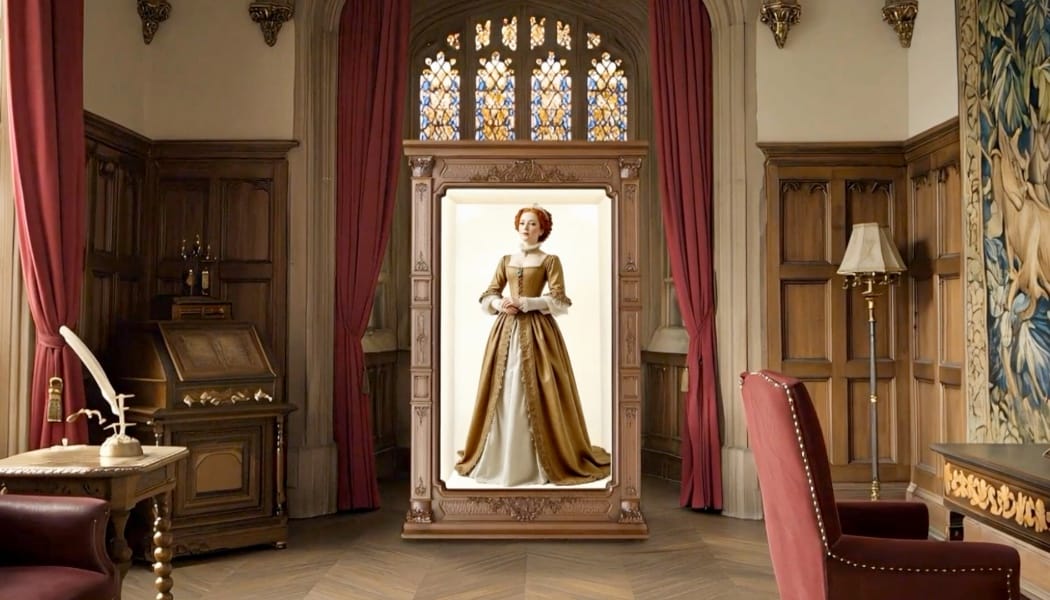
Ailias launching limited pilot programme for museums prepared to engage on content development and ethical governance.
Museums have long been defined by the depth of their knowledge, the care of their scholarship, and their role as custodians of cultural memory. What has changed in recent years is not the richness of what museums hold, but the context in which that knowledge is encountered.
Visitors now arrive with limited time, heightened expectations, and an everyday familiarity with digital experiences that are responsive, personalised, and participatory. Within this environment, even the most rigorous interpretation can struggle to hold attention if it remains purely static. The challenge facing museums today is therefore less about content, and more about connection: how to foster meaningful engagement that is intellectually serious, emotionally resonant, and memorable, without compromising curatorial authority or academic integrity.
It is within this evolving interpretive landscape that a new approach is beginning to emerge — one that shifts interpretation from transmission to dialogue.
From Explanation to Exchange
Conversational interpretation is not a rejection of traditional museum practice, but a development of it. At its most effective, it echoes long-established educational principles: learning through questioning, exploration, and exchange.
Ailias has developed a platform that brings this approach into the gallery space through full-body, conversational holograms of historical figures. These installations allow visitors to ask questions and receive real-time responses that are grounded in carefully curated knowledge bases and shaped in collaboration with subject specialists.
Rather than replacing labels, panels, or guides, conversational holograms act as interpretive catalysts — prompting curiosity, encouraging deeper enquiry, and inviting visitors to engage with collections in a more personal and sustained way.
New Characters, Established Scholarship
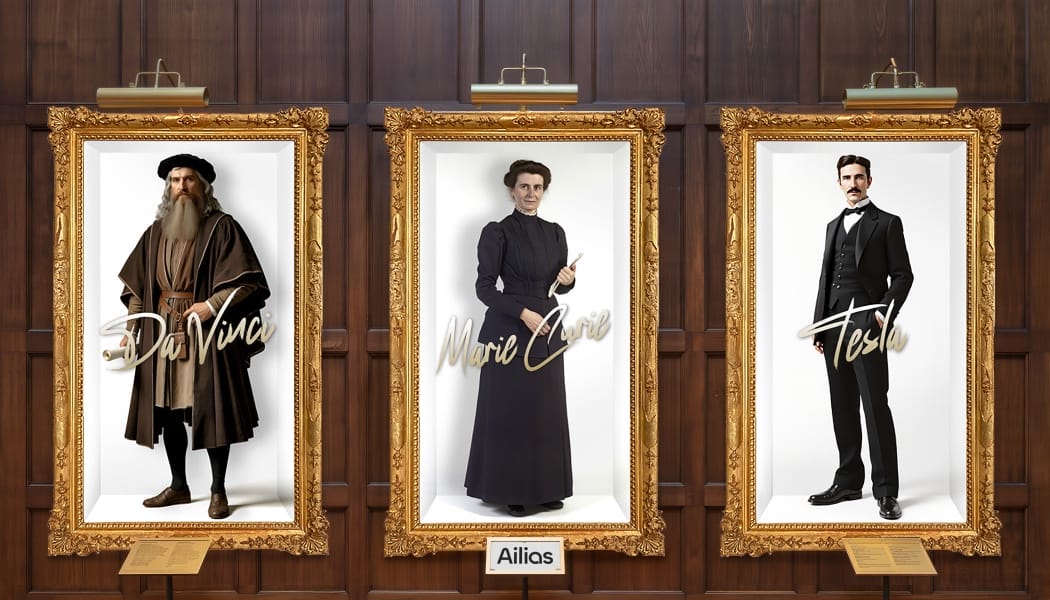
Ailias is introducing three new characters that exemplify both the ambition and the responsibility of this medium:
- Leonardo da Vinci, engaging visitors in conversations about art, anatomy, engineering, and Renaissance thought.
- Marie Curie, addressing scientific discovery, perseverance, and the social realities of research at the turn of the 20th century.
- Nikola Tesla, exploring innovation, electricity, and the ideas that shaped the modern technological world.
Each character is developed not as a caricature, but as a historically situated voice — informed by primary sources, established scholarship, and clear interpretive boundaries. Importantly, Ailias’ approach allows museums to commission bespoke characters, whether global figures or locally significant individuals, ensuring that the technology serves institutional narratives rather than dictating them. And their library of historical characters is expanding each month.
Ethics, Accuracy, and Curatorial Control
The introduction of AI-driven interpretation inevitably raises ethical and professional questions. Who defines what is said? How is speculation avoided? How are historical complexities preserved rather than simplified?
Ailias places these questions at the centre of its development process. Every character is built in collaboration with curators, historians, and educators, with clear parameters governing tone, knowledge scope, and acceptable responses. The system is designed to prioritise accuracy, transparency, and alignment with each institution’s interpretive voice.
In this way, conversational holograms are positioned not as autonomous storytellers, but as carefully governed interpretive tools — accountable to the same standards museums apply to any other form of public-facing interpretation.
Authenticity as an Interpretive Value
Equally significant is the question of presence. Ailias has invested heavily in the realism of its full-body holograms, believing that authenticity of form is inseparable from authenticity of content.
Accurate scale, natural movement, period-appropriate appearance, and physical integration within gallery spaces are treated as essential, not optional. The aim is not spectacle for its own sake, but credibility — enabling visitors to suspend disbelief long enough for genuine engagement to occur.
This focus on realism has positioned Ailias at the forefront of full-body hologram development, creating experiences that feel grounded, respectful, and appropriate to cultural settings.
What Museums Are Observing
Institutions exploring conversational holograms report several consistent outcomes:
- Increased dwell time and repeat engagement
- Strong appeal across age groups, particularly younger visitors
- High levels of organic social sharing, extending reach beyond the museum walls
- Opportunities for premium experiences, partnerships, and sponsorship
Crucially, these benefits are not achieved at the expense of scholarship, but through its careful translation into a new interpretive language.
A Selective Pilot Programme
Recognising both the potential and the responsibility of introducing such technology into museum environments, Ailias is launching a limited pilot programme for museums and heritage organisations.
This programme is intentionally selective. Participation is limited to a small number of institutions prepared to engage collaboratively on content development, ethical governance, and long-term application. The aim is to establish a set of exemplary installations that demonstrate how conversational holograms can be used with integrity, authenticity, and public benefit.
Rather than offering novelty or short-term experimentation, the pilot is designed to support institutions seeking a sustainable, premium interpretive asset — one that can evolve over time and contribute meaningfully to audience development strategies.
Letting History Speak — Responsibly
Museums have always acted as mediators between past and present. Conversational holograms do not alter that role; they intensify it.
When grounded in scholarship, guided by curatorial expertise, and executed with technical authenticity, they offer a compelling new way for visitors to engage with history — not as passive observers, but as active participants in dialogue.
For museums willing to explore this medium thoughtfully, conversational holograms represent not a departure from best practice, but a continuation of it — expressed in a form that speaks to contemporary audiences while remaining anchored in academic tradition.