Alistair Hardaker
Curators worked 18 months with YouTube’s UX team, using Flash emulator and lower-resolution screens to rebuild 2006 page.
A webpage from YouTube featuring the first video ever uploaded to the site has entered the V&A’s collection.
While ‘Me at the zoo’ is still available to view on YouTube, the platform’s design has changed many times in the twenty years since it was first uploaded twenty years ago.
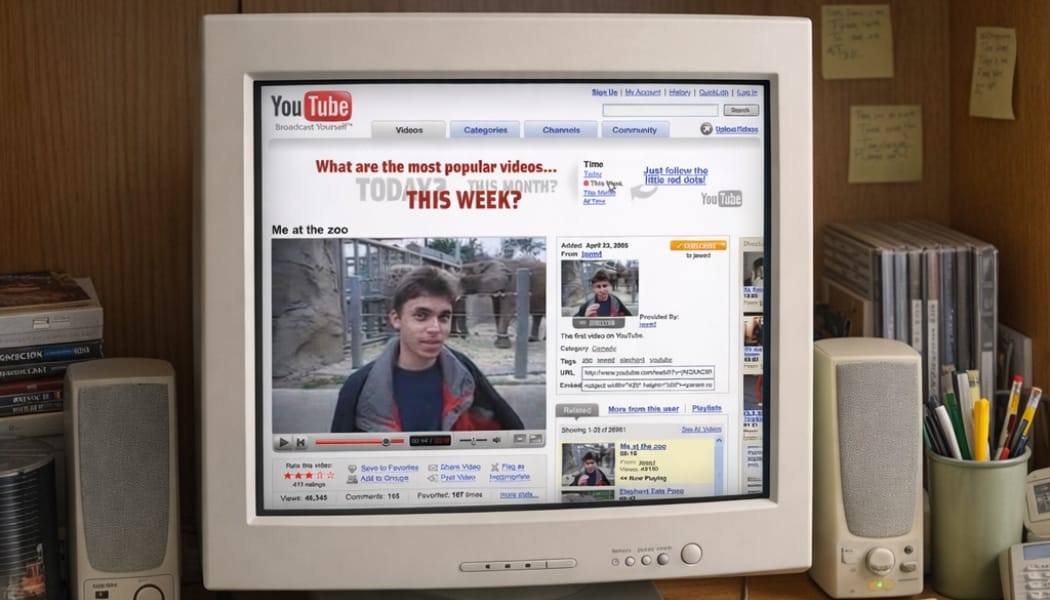
The V&A has not just acquired the video, but reconstructed a version of the page, as it would have looked in 2006.
The V&A’s curators and digital conservation team have spent 18 months in tandem with YouTube’s User Experience team and interaction design studio oio to rebuild the page.
The V&A said the addition brings a “vital piece of internet history into broader dialogue with the museum’s contemporary design holdings”.
Visitors will be able to see the YouTube page at the V&A, and a mini display at V&A East Storehouse will explain the reconstruction process.
The 19-second clip has been viewed nearly 380m times and received over 18m likes since first posted to the platform on 23 April 2005.
The V&A said the video is now considered “a foundational moment in the rise of user-generated content”.
It said the reconstructed page marks an early example of User Interface design conventions, such as badges, rating buttons, sharing and recommendation features – features which continue to shape the internet today.
Previous digital acquisitions include apps such as WeChat, Flappy Bird, EUKI, and the design for the mosquito emoji.
What has actually entered the collection?
The V&A explains that what has entered the collection is made up of three separate digital parts: the original code which makes up the specific video page for ‘Me at the zoo’, the Adobe Flash Player used to play the video, and the video file itself.
The V&A explained that its biggest challenge was that YouTube’s original technology, including its custom video player built on Adobe Flash, is no longer supported by modern browsers.
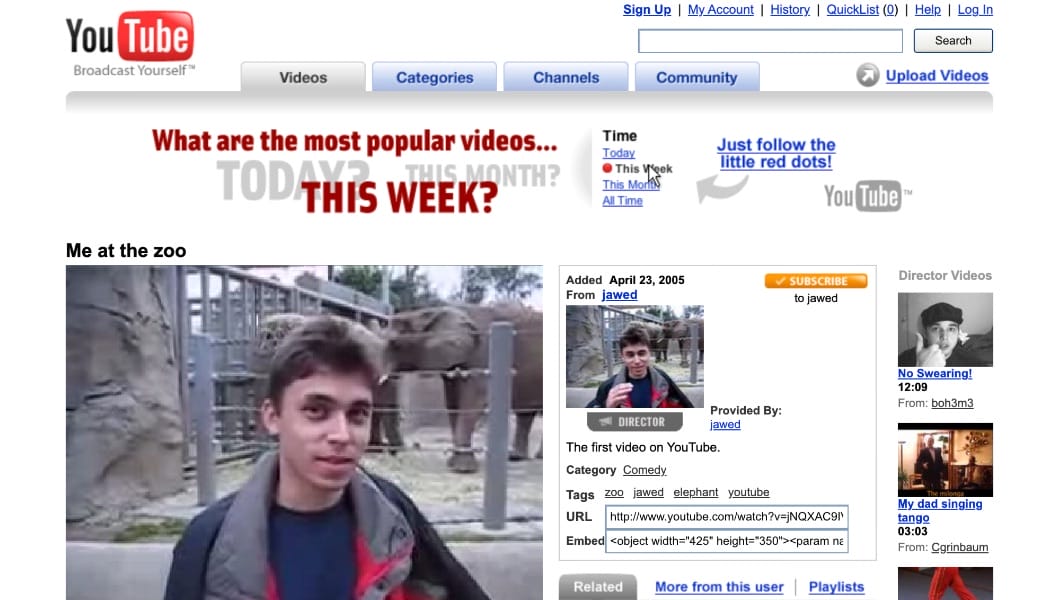
Its team used an open-source Flash emulator called Ruffle to bring it back to life. All changes made to the code were carefully documented with explanatory notes, so that future conservators can understand, reverse, or update them.
Making the reconstructed YouTube page look authentic required solving some tricky technical problems: a browser extension was used to recreate the chunkier buttons and scroll bars of the era, while lower-resolution screens were installed in the gallery so that the image quality matched what visitors would have seen in 2006.
During the project, long-forgotten YouTube adverts from December 2006 and January 2007 were discovered in the company’s own archive, and these have been used to fill the page’s ad banner. The adverts have since been formally acquired by the V&A, adding to the museum’s existing collection of advertising and graphic design.
The V&A said the fast pace of the tech industry “makes looking back and holding on to its history uncommon”. The acquisition is hoped to provide a place for the understanding of how the designed world transforms and shapes society.
Corinna Gardner, senior curator of design and digital at the V&A, said the acquisition “opens new storytelling opportunities for us to showcase and explore the ways in which the internet has shaped our world, from the birth of mainstream video sharing platforms through to today’s hyper visual world and the media and creator economy that go with it.
Gardner added that its work with YouTube “has enabled us to forge new ground in how we collect and preserve complex digital objects for the future.”
Neal Mohan, YouTube CEO, said the project is “inviting the public to step back in time to the beginning of a global, cultural phenomenon. It is a proud moment to see this piece of digital history housed in the V&A where we hope it will inspire generations to come.”
The YouTube watch page is on display at V&A South Kensington as part of the Design 1900–Now gallery and V&A East Storehouse.