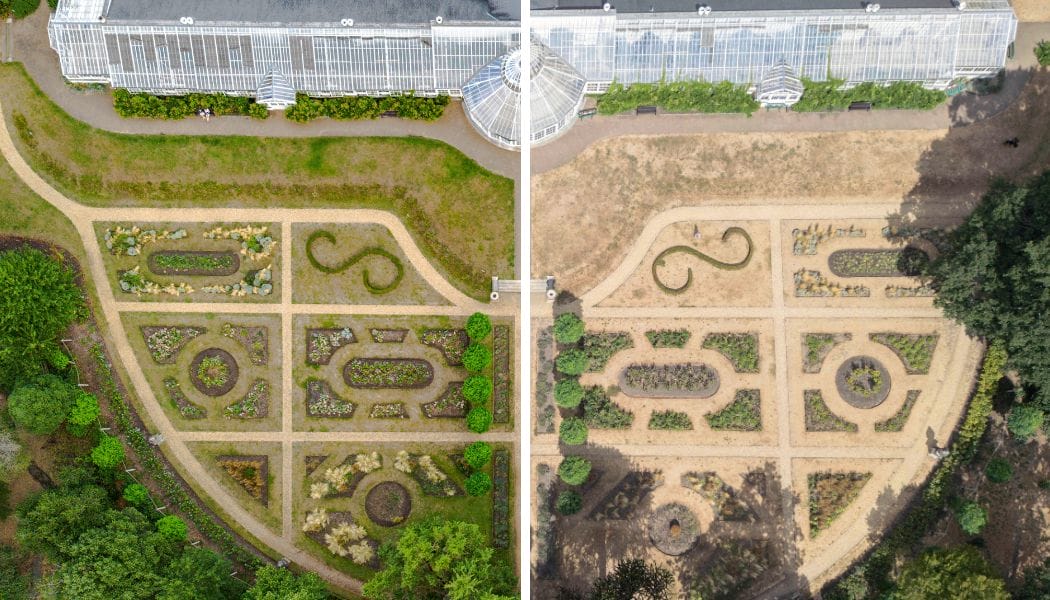
Alistair Hardaker | Image: Images (composite) Chiswick House and Gardens © Historic England
Study by the National Lottery Heritage Fund and Historic England finds historic parks, gardens and cemeteries increasingly vulnerable to climate change.
The UK’s historic parks, gardens and cemeteries are becoming more vulnerable to climate change, with managers unprepared for its impacts, according to a study published by the National Lottery Heritage Fund and Historic England.
The report says there is now a need for increased guidance and support, as all sites are already affected.
As rainfall and storms become more frequent, alongside longer dry periods, pests are thriving in the wetter conditions. The effect of the environmental change now extends to trees, plant collections, habitats, paths, terraces, drainage systems and water bodies.
Erika Diaz Petersen, principal national landscape adviser at Historic England, said the new research “highlights the challenges owners are facing in managing sites in the face of risks such as flooding, drought, high winds and pest and diseases, and the need for advice and support as they work to secure these valuable places for the future.”
According to the report, paths and drainage systems are often no longer fit for present conditions, with sites reporting flooding in places that have not flooded before.
Rainfall and waterlogged soils are also causing erosion and poor tree health, and drought has meant the loss of mature planting. It also says high winds have caused tree loss and structural damage. The report also says the potential loss of entire plant groups to disease is now accepted as normal.
The impacts vary by region, with southeast sites affected by drought, tree loss and irrigation. In the northeast, sites are more affected by rainfall and storms, with the loss of trees and shelterbelts.
Site in the northwest are affected by flooding, erosion, waterlogging, fungal disease and storm damage.
In the southwest, sites report rainfall, made worse by by steep terrain and watercourses, alongside prolonged droughts and gale damage.
The report says historic parks and gardens, including Chiswick, the Royal Parks, Princes Street Gardens and Kew, employ over 32,000 people and contribute £2.9 billion annually to the UK economy from international visitors alone.
Rosie Fyles, head of gardens at Chiswick House and Gardens (pictured above) said: “The threat of climate change on Chiswick’s three-hundred-year-old landscape is for all to see during drought; the gardens are scorched.
“The reality is that our ability as gardeners to minimise the negative effects, particularly on our 1800 trees, is quite limited. My role now is to plan intelligently and make the right informed decisions for the next three hundred years, gathering as much advice and resources as I can to do so.”
The report found that more than half of respondents asked for more accessible information on the climate crisis, including guidance on carrying out a climate change risk assessment. Almost all said funding is essential and that a lack of it is the main reason for not implementing changes. Respondents also identified a need for more centralised information, peer networking and training.
Drew Bennellick, head of land, seas and nature policy at The National Lottery Heritage Fund, warned that “without urgent guidance and advice, many of these precious landscapes will suffer and change beyond recognition.
The National Lottery Heritage Fund and Historic England said they intend to work with stakeholders to develop an action plan to support owners and managers of historic parks, gardens and cemeteries. Gardens including Chatsworth have recently featured in coverage of the heat’s effects, in some cases revealing the shapes of gardens lost to history.
Read the full report here