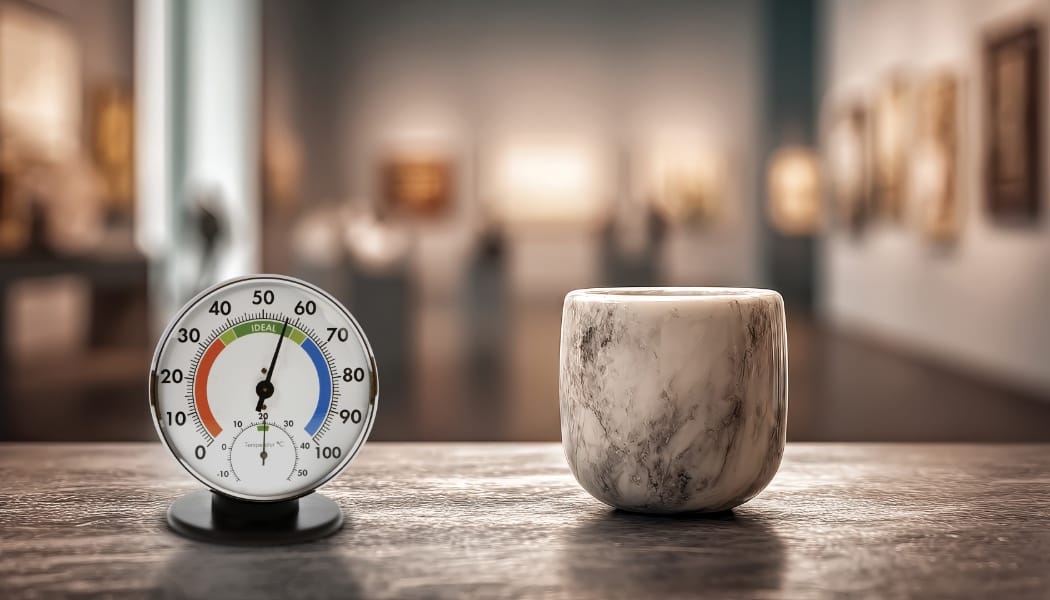
Image: Hygrom with cup in gallery museum (Condair)
Dave Marshall-George, Strategic Accounts Manager at Condair, looks at the complexities of indoor humidity control in heritage sites.
Maintaining stable indoor humidity in museums, galleries, archives and stately homes is vital for the successful preservation of artefacts. Artworks and antiques contain hygroscopic materials, including wood, textiles, paper and animal products, which absorb moisture from the surrounding air or release it back. Fluctuations in their internal moisture content produce small dimensional changes, causing degradation over time. Excess humidity can also cause condensation, encouraging fungal growth and mould.
Beyond preservation, environmental control underpins exhibit loans and insurance, which can depend on closely managed conditions. Humidity, temperature, light and UV levels may require tight regulation around the clock. Conditions outside agreed limits can lead benefactors to refuse loans or insurers to withhold indemnity.
Conservation organisations have published various environmental guidelines over the years. A common current standard for heritage buildings, from the Bizot Group, is 40–60% relative humidity (RH) and 16–25°C, with fluctuations within that humidity range limited to ±10%RH per 24 hours. Rapid fluctuations are more damaging than gradual changes because materials have less time to adapt. Guidance therefore addresses both the acceptable range and the rate of change.
The ideal air humidity for any material is an equilibrium between the object’s moisture content and the atmosphere, which prevents any moisture loss or gain. Known as equilibrium relative humidity (ERH), this differs greatly between exhibits because different materials have varying internal moisture levels.
A blanket humidity range with an acceptable rate of change may be very a practical way to manage heritage buildings, but not necessarily the most economical, given the varying needs of exhibits. Humidity control consumes energy, so tailoring conditions to exhibits’ specific requirements can widen the acceptable humidity range. This can reduce both energy consumption and operating costs.
The 2023 Bizot Green Protocol recognises this, promoting a “greener practice first mindset” for object care. While supporting the 40–60%RH standard, it recommends set-points based on a conservator’s evaluation of individual exhibits’ requirements. Appropriate conditions therefore depend on the materials being protected.
Where maintaining the required environment throughout a whole room is difficult, cabinets or enclosures can provide local control. This is particularly useful in entrance halls and large open spaces. Revolving doors and vestibules reduce incoming outdoor air and moisture ingress. However, commercial buildings must ventilate at a minimum of 10 litres per second per person, so excluding outside air is not a practical humidity control solution. Technology remains essential.
Humidifiers add moisture; dehumidifiers remove it. Where both operate, a sufficient control “dead-zone” of 10%RH between their set-points prevents the systems working against each other.
Systems can treat air centrally within a building’s air handling unit (AHU) or locally within individual rooms. The building largely determines the choice. Central control is easier to manage where ducted air treatment already exists. Many older heritage buildings lack ductwork, making multiple in-room units the only option. In public areas, these must have tamper-proof controls, operate hygienically and be robustly safe.
Visitor numbers can rise suddenly. A coach party arriving from the rain with wet clothing and umbrellas introduces considerable moisture. Systems must respond rapidly to control signals to minimise fluctuations.
Resistive steam humidifiers are popular in museums and galleries with centralised ducted systems, offering fully modulating output from 0–100% and close humidity control. A fan attachment allows direct room distribution, but hot internal components and high-voltage electrics mean they are not usually recommended for public rooms. They are ideal for non-public spaces such as archives without an AHU.
Mobile evaporative humidifiers are often chosen for in-room humidification. High-quality professional units offer tamper-proof controls and can be plumbed in for fully automatic operation, providing an easily installed solution for heritage applications. Their mobility also allows them to be stored away when not needed.
Commercial dehumidifiers use either condensing or desiccant technology. Desiccant units suit very low humidity or cold conditions; condensing units dry efficiently at moderate temperatures and above 50%RH. Museums and galleries commonly operate in this middle range, making condensing units popular for in-room use, with roughly half the energy consumption of an equivalent desiccant unit.
Condensing units require a drain connection. Desiccant units need no drain but require additional ducting to exhaust hot, wet air outdoors, often making condensing equipment easier to install. However, desiccant technology is often preferable below 15°C, for very low humidity targets or for in-duct dehumidification.
Finally, every humidity control system needs occasional maintenance, particularly humidifiers. It is therefore advisable to work with suppliers who can help with initial system design and installation, while providing support throughout the equipment’s operating life.
A more comprehensive explanation of humidity control in heritage buildings is available from the Condair website on www.condair.co.uk/heritage or alternatively for an even deeper dive a webinar is also available on www.condair.co.uk/heritage-webinar.