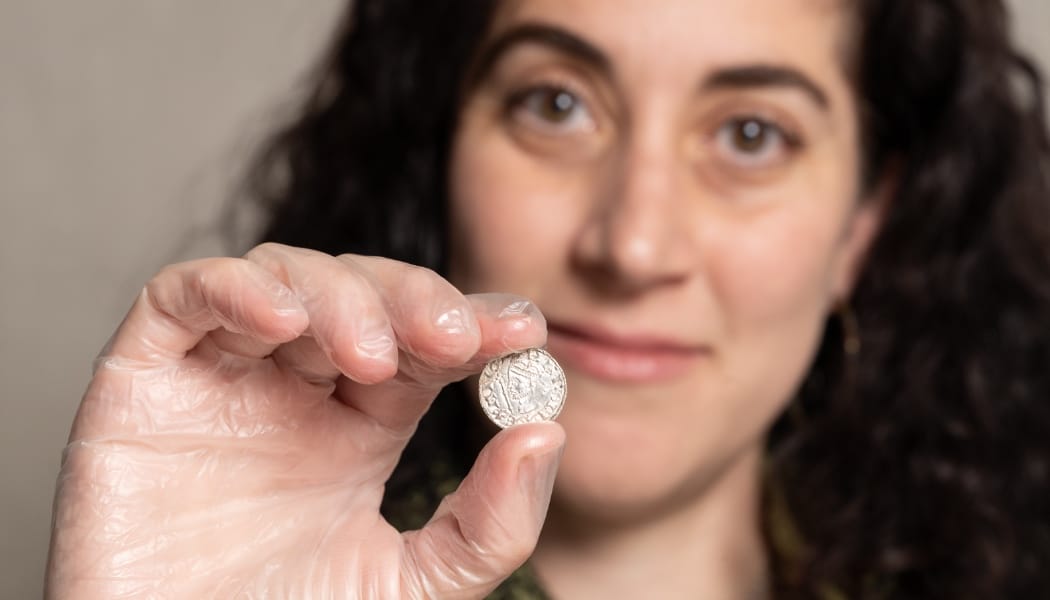

Image: South West Heritage Trust Curator of Arrchaeology Amal Khreisheh with a coin from the Chew Valley Hoard ©SWHT
Eilish McGuinness, Chief Executive, explains the impact National Lottery funding is having for heritage treasures – from sculptures and paintings to habitats and landscapes.
Supporting acquisitions and securing the future of the most important heritage of all types for future generations is a key part of The National Lottery Heritage Fund’s Heritage 2033 strategy.
Why investing in acquisitions matters
Cromwell’s watch, a Barbara Hepworth sculpture, a Norman treasure trove and an historic landscape – these are just some of the extraordinary elements of UK heritage that have recently been saved thanks to National Lottery funding.
Our consultation for Heritage 2033 demonstrated the need for funding to support acquisitions of important heritage to safeguard these treasures and share with future generations.
That is why, in our Heritage 2033 strategy, we made a commitment to supporting acquisitions that align with our four investment principles: saving heritage; protecting the environment; inclusion, access and participation; organisational sustainability.
Acquisitions matter to both heritage bodies and the public. For some it can ensure a museum or gallery artefact becomes part of a public collection, for others it enables buildings or land to be safeguarded, shared and enjoyed by everyone. We know that acquisitions enrich the stories of places, create new opportunities for learning and engagement, help develop partnerships, attract visitors and spark pride in places.
We see heritage as anything from the past that people value and want to pass on to future generations, and it is wonderful to see the range of acquisitions we have supported and the lasting benefit it has for people and communities.
Crucially, acquisitions are often just the beginning. Our funding frequently supports the next chapter – helping organisations make those acquisitions central to their future.
Thanks to National Lottery players, we are able to support acquisitions that secure heritage at moments when it is most at risk and ensure it can be enjoyed by people across the UK, now and in the future.
An agile approach
We don’t simply fund the purchase of an object, collection or landscape. We expect acquisitions to do more: to increase public access, expand interpretation, contribute to wider organisational sustainability, engage communities, and be shared as widely as possible.
We know that opportunities to acquire significant heritage can arise unexpectedly, and often under considerable time pressure. That is why flexibility is built into our approach, enabling us to respond quickly when unique opportunities emerge.
Our two-round funding approach, which includes a development phase and a delivery phase is used for most of our projects applying for more than £250,000 and can be especially important for time-critical acquisitions. It allows us to help organisations act quickly to secure heritage at the development stage, while also ensuring the acquisition is embedded in a well-planned wider project for which funding is applied for at the delivery stage.
A strong example is the Chew Valley Hoard. Discovered in 2019 by seven metal detectorists in the Chew Valley area of Bath and North East Somerset, this nationally important treasure includes 2,584 silver pennies dating from 1066–68. The coins were likely buried for safekeeping during the upheaval of the Norman Conquest of England.
In 2024, we awarded development phase funding to support the urgent acquisition of the hoard. This enabled South West Heritage Trust to secure ownership, begin conservation work and continue developing a wider project around it.
In 2025, we awarded delivery phase funding for an ambitious two-year engagement project to celebrate the Hoard and create an exciting new gallery at The Museum of Somerset.
Part of a wider funding picture
Of course, we are not always the sole funder of acquisitions. Our support is often part of a wider funding picture which brings together funders, organisations and the public to secure a heritage treasure. Funding campaigns help to not only raise the money needed but also help to forge connections between organisations and build resilience in the sector.
One exciting recent example of the power of collaboration and partnership funding was the acquisition of Dame Barbara Hepworth’s Sculpture with Colour (Oval Form) Pale Blue and Red. In 2024 the UK Government put a temporary export bar on the sculpture to give a UK museum a chance to acquire it before it was potentially lost to collectors overseas.
The Hepworth Wakefield rose to the challenge and raised an incredible £3.8m for the acquisition from a range of funders. Crucial to the effort was a successful public fundraising campaign run by Art Fund in collaboration with the Hepworth and underpinned by £1.89m from the Heritage Fund.
The sculpture went on display in September 2025 and is now a key part of the story of Hepworth Wakefield, which was founded with support from the Heritage Fund, and her hometown of Wakefield. The sculpture is currently on display at the Courtauld Gallery as part of a major retrospective of Hepworth’s work until 6 September, allowing even more people the opportunity to see it.
Enriching stories and widening access
Whether the acquisitions we support cost thousands or millions of pounds, they play a vital role in deepening understanding, reuniting heritage with place, and reaching new audiences.
Some acquisitions help keep heritage close to where it belongs – returning objects to the landscapes, places or communities they are most closely connected to.
Earlier this year we supported the acquisition of Oliver Cromwell’s pocket watch by the Cromwell Museum in Huntingdon with a grant of £54,450. It is one of only two watches thought to have belonged to Cromwell, with the other in the British Museum. Born in Huntingdon in 1599, Oliver Cromwell attended school in the building that now houses the Cromwell Museum. The watch is now part of the museum’s permanent collection which allows visitors to explore the facts of his life and make up their own minds about the controversial figure.
Nearly a decade ago, we also supported the acquisition of Sir Edwin Landseer’s iconic The Monarch of the Glen after news emerged that the painting would be put up for auction. Our major grant of £2.75m, alongside others, helped secure the asking price of £4m to ensure this famous work could remain permanently in Scotland at The National Galleries of Scotland (NGS). Following the major restoration of NGS, supported by nearly £7m of Heritage Fund investment, it hangs alongside other iconic images, and is a focus for local, national and international visitors, and ‘encapsulates the grandeur and majesty of Scotland’s highlands and wildlife’ for many people.
Acquisitions also create new opportunities for collaboration and shared interpretation.
The acquisition of William Dobson’s self-portrait is a compelling example. Acquired in a partnership between Tate and the National Portrait Gallery, the painting will be shared and exhibited alternately in both venues, reaching wider audiences and offering different contexts for interpretation. This self-portrait is one of a pair Dobson painted. The other shows his wife Judith and was already a part of Tate’s collection. He likely created both paintings as private works to be displayed in the couple’s own home. Now the pair can be reunited and hung together on display.
Not many works by Dobson have survived – these two portraits are the only ones known to exist before his time at King Charles’ exiled court in Oxford, which made the acquisition even more exciting.
The story of this remarkable painting and it being secured for the UK is only one part of the story, with a vibrant programme of activity also funded which will introduce new audiences to Dobson and his work, exploring themes such as self-representation, art during conflict, and drawing connections between the 17th century and present-day challenges. The self-portrait will also tour partner venues across the UK that hold works by Dobson in their collections or have a link to the English Civil War.
Supporting nature recovery
Protecting the environment and increasing people’s understanding and connection is one of our four investment principles and is increasingly important. Our support for acquisitions extends to landscapes and nature where land purchase and public ownership is essential to long-term conservation and can help organisations protect and restore important natural heritage.
Land acquisitions can connect habitats, kickstart nature recovery and improve public access to the natural environment creating lasting benefits for wildlife and landscapes and connecting communities with nature across towns, cities and countryside.
In Northumberland we are supporting the Wildlife Trust’s ambitions for the acquisition of the 3,800ha Rothbury Estate. Earlier this year we announced funding of nearly £5m towards the £30m purchase cost which the Wildlife Trusts are working incredibly hard to raise by September. If successful, the Wildlife Trusts plan to restore and protect the Rothbury Estate, creating a landscape where wildlife and people thrive together. Working with local communities and farmers, the project will support nature recovery at scale, improve access, and celebrate the area’s natural and historic heritage for future generations.
.
Discover more
Since 1994, we have awarded £2.5 billion to more than 6,000 museum, library, archive and collection–based projects across the UK. From paintings and archives to landscapes and historic places, acquisitions continue to play a vital role in protecting our shared heritage.
Since 2023, when we launched Heritage 2033, we have awarded £28million to almost 40 projects involving an acquisition. From paintings and archives to landscapes and historic places, acquisitions continue to play a vital role in protecting our shared heritage.
Discover more inspiring projects we’ve funded and learn how, thanks to National Lottery players, heritage is being secured for everyone, for the long term.