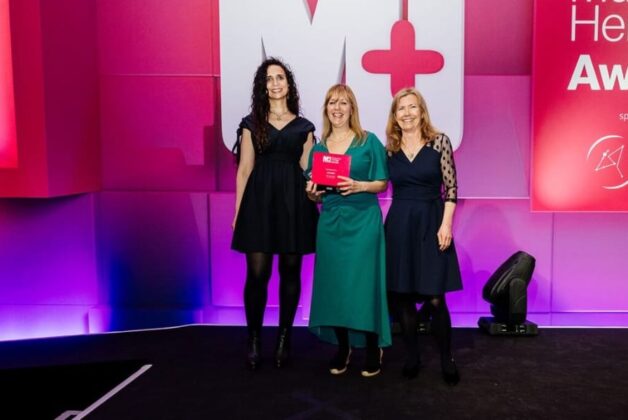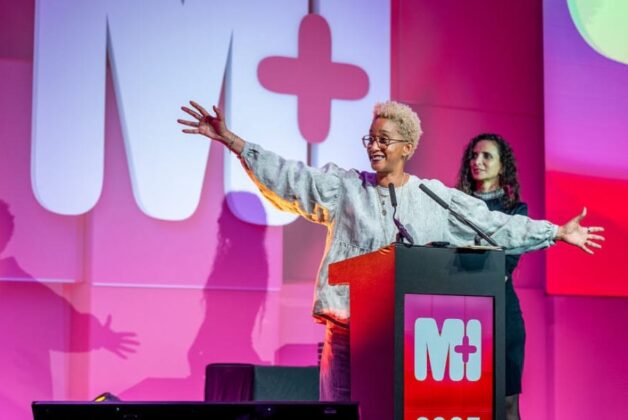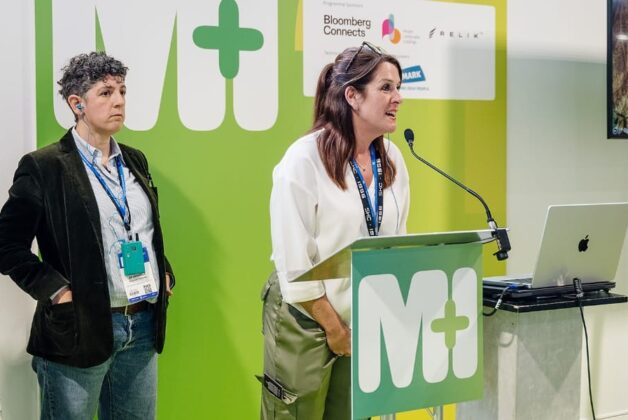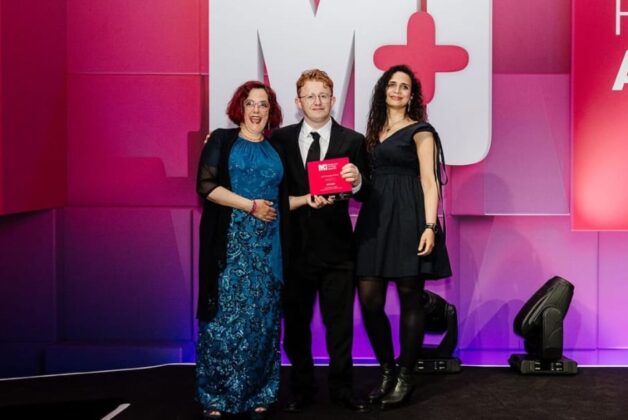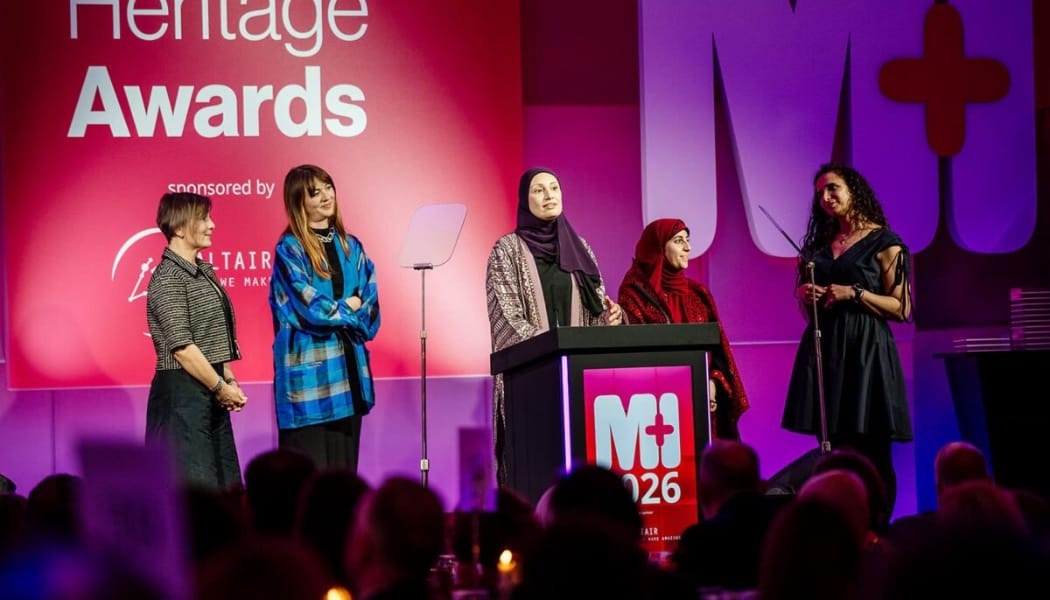
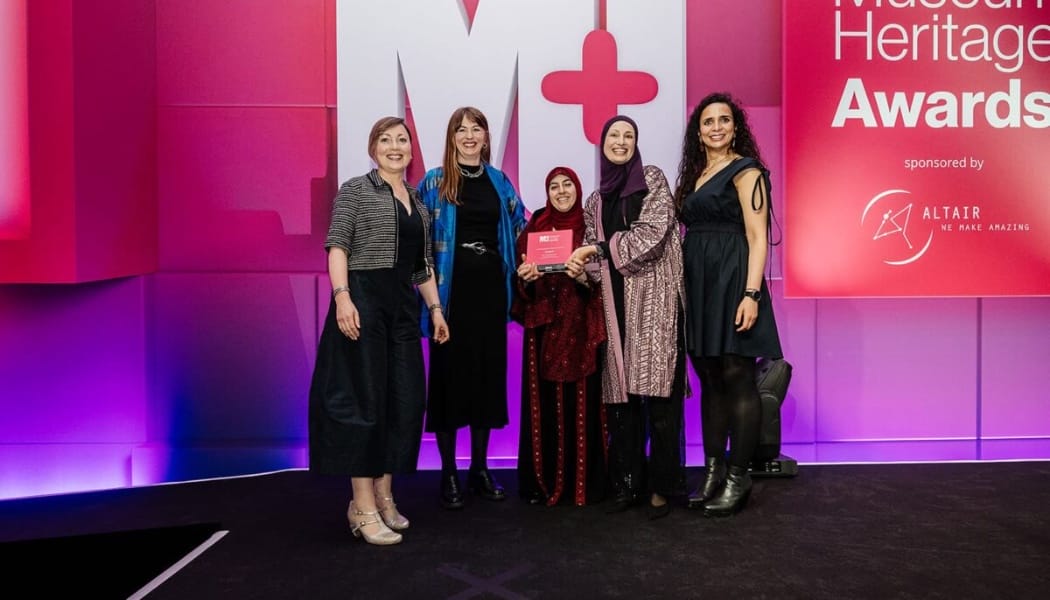
Alistair Hardaker | Image: The 'All Eyes on Her! / كل العيون عليها' team receive their award at the Museums + Heritage Awards 2026
All Eyes on Her! / كل العيون عليها won Community Engagement Programme of the Year for changing how a museum works, not just how a display reads. Heba Abd El Gawad on why ‘consultation’ didn’t do the project justice.
The Museums + Heritage Awards judges described Horniman’s winning programme as going “far beyond consultation to deliver genuine institutional change”.
Heba Abd El Gawad, senior curator of anthropology at the Horniman and the project’s lead AHRC research fellow, agreed, and said consultation was never the aim.
“I would never describe [the project] as consultation because I’m Egyptian myself. So I would find it extremely insulting that I’m consulted on how my heritage is cared for or represented or displayed in the UK, while in many cases it shouldn’t have been here to begin with.”
All Eyes on Her! / كل العيون عليها took Community Engagement Programme of the Year at the Museums + Heritage Awards in May 2026.
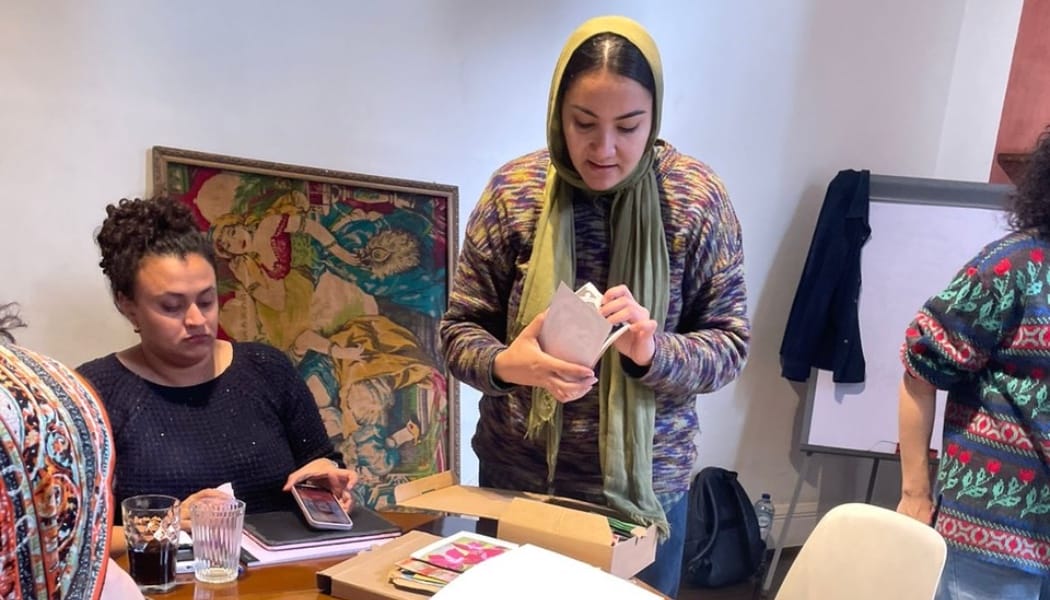
The display, bilingual in parts, has been developed with Egyptian women and women-led initiatives in London, Cairo, the Egyptian Delta and Luxor, working in partnership with the Horniman.
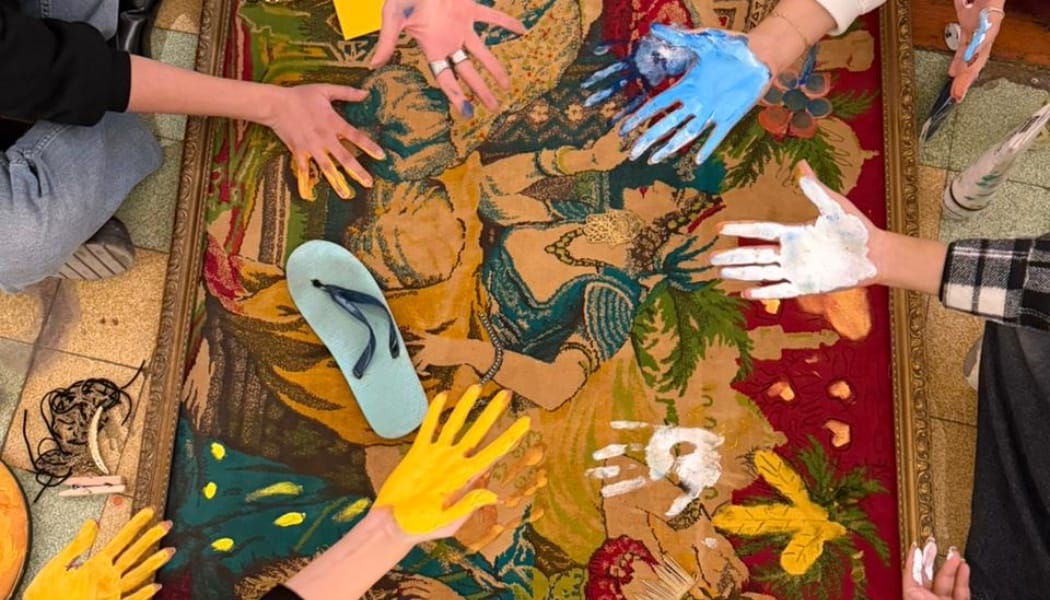
Work first began in 2019 with Egypt’s Dispersed Heritage, an initially UCL’s now mainly community-led project examining the colonial legacies of five UK museums that came to focus on the Horniman’s full operations.
Out of those discussions came All Eyes on Her! / كل العيون عليه. developed with Egyptian women and women-led initiatives in London, Cairo, the Egyptian Delta and Luxor from 2021. It ran inside a second UCL project, the AHRC funded Mobilising Collections Histories for Institutional Change: Egypt at the Horniman.
The project and resulting display opened at the Horniman in April 2025 and runs until 2028. The display, bilingual in parts, opened in April 2025 and runs until 2028.
Abd El Gawad says the display is one output among many, not the project itself. “The display is only the physical output, one of many outputs,” she told Advisor.
The display’s text was written through community-led creative writing workshops rather than by the museum, translated in Cairo by 17 Egyptian artists, writers, teachers, lawyers and heritage practitioners.
Contemporary artist, writer, translator, and art curator Fatma Elzahraa facilitated the translation into colloquial Egyptian Arabic rather than the formal standard, and on Horniman’s website the Arabic text carries their byline, not the museum’s: the community translators, supervised by Elzahraa.
The partners run well beyond the usual community-group roster too. Comic artists and collectives including Nasser Junior, El3osba and Deena Mohammed, publishing and art book initiatives including Zine bel 3arabi and the CairoComix, alongside educators, filmmakers, designers, feminist networks and social welfare initiatives in Egypt and the UK.
“There are two terminologies that I hate, ‘consulting communities’ and ‘critical friends’, particularly if you are a source community and if this is your heritage, because it immediately assigns a power structure.
“Communities have far less power than the museum, but they’ve got far more knowledge. Equally they have the rightful ownership; they are the rightful owners of this heritage.”
An internal investigation
2019’s Egypt’s Dispersed Heritage project with UCL examined the colonial legacies of five UK museums, undertaking a critical social history, characterisation, and appraisal of a museum collection.
What Abd El Gawad shared with Egyptian community partners went well beyond the collection.
“I shared everything, all the data that the museum has on the Egyptian heritage that is at the Horniman.
“I shared the learning sessions that we lead. I shared any decision making process that is made around Egypt, even something as simple as the museum shop – I shared with the communities everything that is being sold related to Egypt.”
It was far more than a consultation, instead, Abd El Gawad describes “an investigation into how Egypt is being spoken about, handled, represented, even cared for in the storage.”
The subject of the display emerged from that process rather than preceding it. “Most of the belongings actually could be traced back to Egyptian females or Egyptian women. The decision was that this has to be a project on women.”
‘Resist, revolt, reclaim’
Emerging from the projects’ themes, ‘Resist, revolt, reclaim’ became sub-headings within the display, but were more significant in the wider thinking about the project.
“They were not just section titles, it was the ethos that the project was operating around.”
Abd El Gawad is direct about what the project is resisting, including the terms with which Egyptian women are usually received in the West, including stereotypes of women from the East “as exotic or oppressed or having no rights. And they are never seen as active protesters. They are never seen as activists.”
“We wanted to show that we have our Egyptian forms of feminism, that women’s struggles are actually universal. Many of the stigmas we struggle with in Egypt, which people here look down on, are perceived as a bit uncivilised or behind, but women here face exactly the same struggles.”
She is equally sharp on labels. “Many of us do these acts of everyday activism and we do not call ourselves feminists because it’s our way of being. It’s the only way that you can exist in the world. People here are so keen on having a label for it. If you don’t have a label for it, it doesn’t exist.”
The displayed ancient material is also framed accordingly. “We’re not focusing on the traditional death in ancient Egypt, mummification, or the gold. We’re focusing on how the Egyptians experienced life in ancient Egypt.”
What actually changed
The institutional outcomes Abd El Gawad has brought to the museum are not just display decisions.
Conversations with Egyptian communities fed into a revised human remains policy at the Horniman in 2025, which recognises human remains, “as once-living people or parts of living people, and belongings made from or incorporating human remains have a personal, cultural, symbolic, spiritual or religious significance to Indigenous, source, and/or descent communities, countries, and communities of association.”
Learning sessions were rewritten towards contemporary Egypt rather than only the ancient. The permanent Egypt display now carries Egyptian voices through comics, including Egyptians publicly denouncing how mummified ancestors are presented in the West and naming the Horniman’s own colonial legacy.
And the continued amplification of community voices continues. “Now, whenever the museum, or I, am invited to give a talk about Egypt or about any of the projects we’re working with in the Horniman I bring along the community members working with us, so they are the ones giving the talk, not me.”
Abd El Gawad even included these community members in the Museums + Heritage Awards application process, which went on to win.
“That’s how the power is changing from the Horniman to the communities. Even when the Horniman represents the work, it’s represented by the communities who were actively doing the work. They’re not just being consulted, and they get rewarded back for their time.”
Belongings, not objects
Abd El Gawad is also pushing for changes to language within the institution which, though small, challenge institutional thinking.
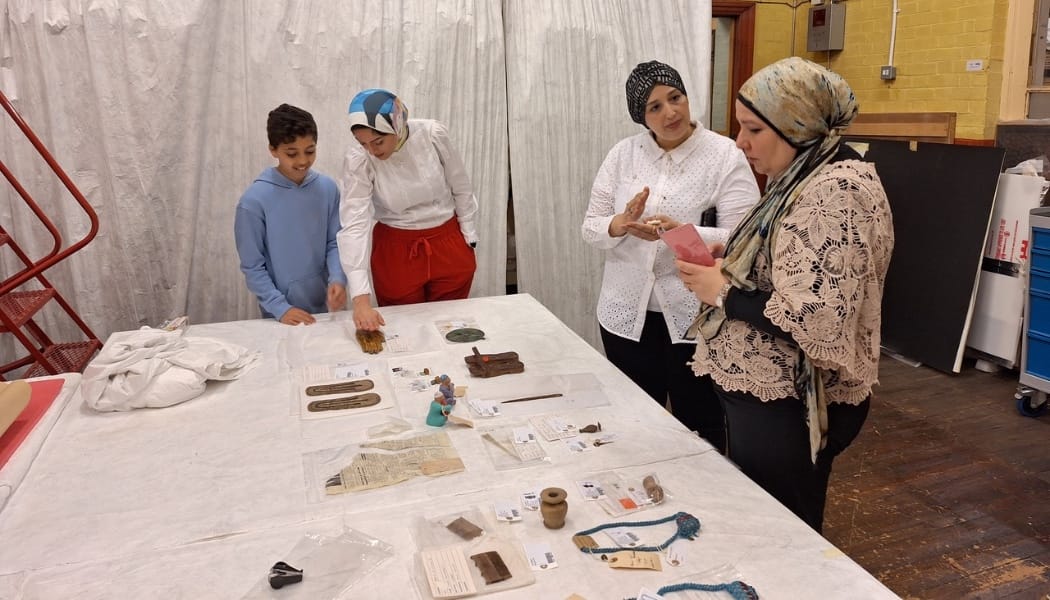
“Even for my colleagues, it wasn’t obvious why I’m [using the word] ‘belongings’ and not ‘objects’. It’s something that I had to explain.”
“They came from somewhere. They belong to someone. So they are belongings. They are not just ‘things’. When you call them objects, they lose this connection, and the way you see them becomes detached from the source communities.”
That change has taken hold. “Everyone, whenever they see me, they make sure that they never say the word ‘object’,” Abd El Gawad says, laughing.
She draws a line from museum display to contemporary, divisive politics. Museums do have a responsibility and they play a role, she argues.
“Sometimes your only encounter with other cultures is in a showcase. And if the showcase shows only the ancient heritage, without the contemporary voices, you would think that this is a heritage that is frozen in time and place and it has no descendants.”
“In reality, many of the founding collections of museums in the UK come from Syria and Iraq, but people here are used to seeing ancient Syria and ancient Iraq. They struggled to see the Syrians and Iraqis as humans because they never saw them.”
“It’s very rare in the UK that the curator would be Indigenous, coming from the same culture where the heritage has been extracted.”
Entries for the Museums + Heritage Awards 2027 open on Monday 2 November 2026 — don’t miss your chance to be recognised among the sector’s best.
Be first in line with entry details, deadlines, and insider tips to strengthen your submission.
The transferable part
The judges called the project’s approach of deeply shared stewardship a transferable model. Abd El Gawad’s version of what transfers is uncomfortable for anyone hoping to copy a display format.
“I was working really hard on looking at the internal museum practices or structures that led to these stigmas or stereotypes, rather than just changing the display.”
“This is why I find these consultations problematic. Communities are invited in and they are consulted about their heritage; we change a few labels here and there, and that’s about it.
“But it’s not about that. It’s about how every day we talk about this heritage, even in a staff meeting. How we differentiate between the rights of the audiences and the rights of the communities of source, even when we’re writing forward plans.”
“Otherwise you’ll be replicating the same model unconsciously, and you’re just repairing from the outside… It would look ethical but only from the outside.”
Asked about methodology, Abd El Gawad explains that the strategy needs a further step back. “Museums always worry about ‘what is the methodology?’… I had no methodology. I just treated people as people who have rights and responsibilities, that I’m accountable to them, but they are equally accountable to me. None of us are victims, none of us are perpetrators.”
And she argues the benefit of this approach runs both ways. “Transforming these practices is better not only for Indigenous communities’ rights, but equally for the museum, because the practice of the museum itself will improve. All of the structures we operate with are structures that we’ve inherited years ago.”
“The more that you’re open to other ways of doing, seeing and being, the better. The better your practices would be, and the more you will realise as a museum that you are not an authority, and you shouldn’t be.”
Entering the awards, and what comes next
Abd El Gawad was motivated to enter the Museums + Heritage Awards for a specific reason. “Every museum prides itself on having an ancient Egyptian display, but nowhere would you see Egyptians around these displays. It’s becoming part of British social history without us. So I felt I wanted to put this back into the narrative.”
The application was written with the partners, including their own quotes. “I’ve shared it with the communities and they’ve had their input on what to highlight.”
On finding out the project had won, Abd El Gawad said the collective effort meant “we felt seen”.
One partner’s input has stayed with her. “One of our community members always says that what we’re doing here always feels like a national duty. And I think that we fulfilled it.”
“It was important for me to make sure that this doesn’t become a one-off project, and for the institution to see that it’s rewarding to work this way.”
That commitment has already paid off. A community-led exhibition in Cairo last year asked participants what they would do if they could build their own museum about Egypt, running a two-week workshop with around 28 contributors before they staged the results in a Cairo gallery. Their answer looked nothing like a gallery.
Next is ‘Uncollectable’, a community project and exhibition led by Hekayyatna, the Horniman, and UCL widening the approach to South West Asian and North African collections with commissions including new photography from Iraqi photographer Abbas Alasadi, contributions from writers in Gaza, and Tatreez artist and researcher Haya Netsheh completing an unfinished Palestinian tunic known as a thobe, and textile collage piece by Halima Ibrahim.
“It talks about all the stories that museums cannot hold, because you can hold the thing as an object, but you cannot hold the knowledge, the experiences, the lives that come with it.”
“If it weren’t for ‘All Eyes on Her’ and the success we had, it would have been tricky for me to advocate for transforming practices within the museum. The award did help in showing the value of doing this work.”
All Eyes on Her! / كل العيون عليها is at the Horniman Museum and Gardens until 2028. Entries for the Museums + Heritage Awards 2027 open on 2 November 2026.
Entries for the Museums + Heritage Awards 2027 open on Monday 2 November 2026 — don’t miss your chance to be recognised among the sector’s best.
Be first in line with entry details, deadlines, and insider tips to strengthen your submission.