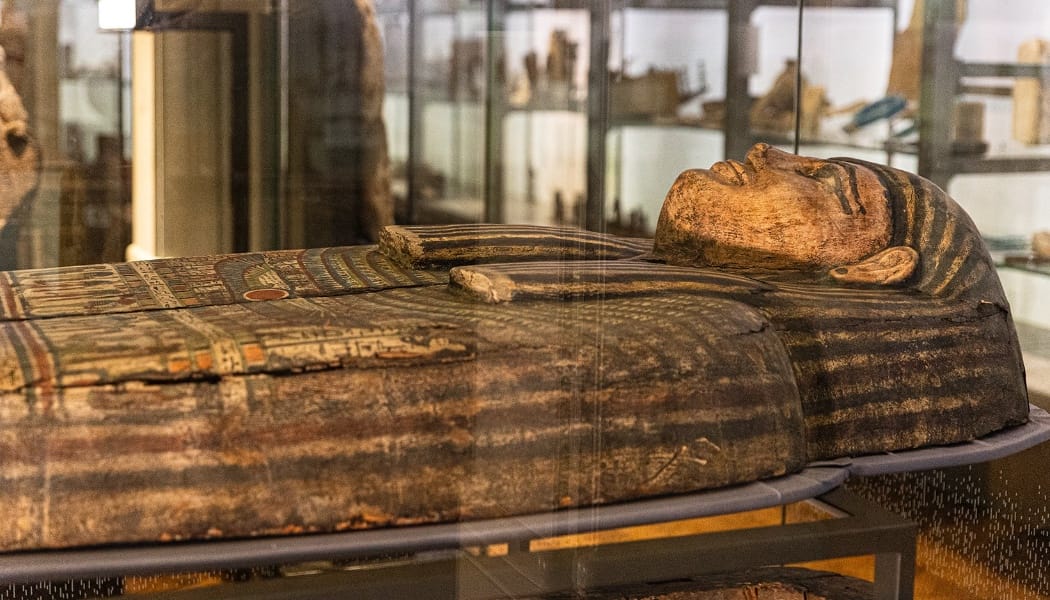
Alistair Hardaker | Image: Asru, formerly on display at Manchester Museum
Manchester Museum has removed Asru, a mummified Egyptian woman displayed in the city for two centuries, from its Egypt and Sudan Gallery.
Manchester Museum has removed the mummified body of a woman known as Asru from display, ending two centuries during which she was on display.
Asru’s remains were initially displayed at the Museum of the Manchester Natural History Society. She was unwrapped at the Manchester Natural History Society in April 1825 and displayed almost continuously in the city in the two centuries that followed.
After the Museum of the Manchester Natural History Society closed in the 1860s, the remains were transferred to Owens College, which later became the University of Manchester.
Her most recent display dated to the opening of Manchester Museum’s ‘Ancient Worlds’ galleries in 2012, where she was partially obscured from view. Asru’s display in the museum’s Egypt and Sudan Gallery ended earlier this month, September 2026.
According to the museum, the decision to remove her from display reflects changes in how it thinks about its responsibility towards what it describes as ancestors, museum collections and the communities they represent. The museum said it consulted Egyptian colleagues, members of the Egyptian diaspora and visitors before making the change.
The museum said the decision also aligns with what it understands about Asru’s own wishes, noting that elite Egyptians of her time expected their mummified bodies to remain wrapped in their coffins and unseen by the living.
Asru now lies in the museum’s stores within her outer coffin, which will remain closed.
The museum said this is not intended to be her permanent resting place, and that it is now considering how to better care for ancestors in line with the wishes of the dead and of living communities.
The museum said this could mean creating more suitable resting places within the museum, or considering the return of ancestors to communities of origin.