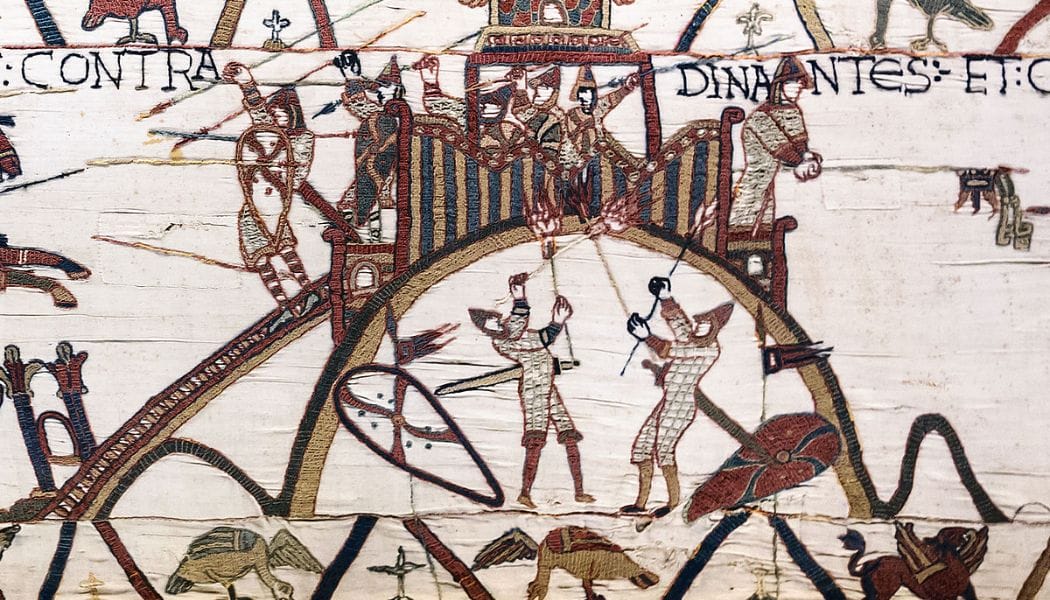
Alistair Hardaker | Image: A section of the Bayeux Tapestry (CC BY-SA 4.0 LiamGM)
Trustee and director say Bayeux Tapestry loan could be a model for British Museum to share its collection internationally.
The British Museum’s director and a trustee have pointed to the loan structure behind the Bayeux Tapestry as inspiration for the museum to share its collection more widely.
British Museum trustee Dame Tracey Emin has said the museum should share its artefacts with the world, inspired by France’s loan of the Bayeux Tapestry.
“If [the tapestry] comes here, it means things from here can go to other places.” Emin told ITV News outside the museum, ahead of its sold-out exhibition opening last night.
“It’s the beginning. That’s what I’m hoping, anyway. As a trustee, it’s time we started sharing the artefacts and amazing things we have in the world.”
Asked by ITV News if she was referring specifically to the ‘Elgin Marbles’ or Parthenon Sculptures, she said: “I’m referring to everything.”
Emin said around half of the artefacts in the museum were found in Britain, while 30% were gifts from abroad. Emin said the remaining 20% were “controversial”.
“I think it’s something that needs to be resolved, and it will be in time,” Emin said.
It is unclear if Emin was calling for increased international loans or the more controversial issue of repatriation, for which the Parthenon Sculptures’ return to Greece have long been a prominent example.
The British Museum already lends many artefacts internationally as part of its core mission, but stipulates that the borrowing institution acknowledges the museum’s ownership of the object. Repatriation is legally distinct: the museum says it is barred from permanently disposing of collection items under the British Museum Act 1963, a restriction only Parliament can change.
Last month the museum’s director Nicholas Cullinan told the Financial Times that the loan of the tapestry was “a very compelling example of international partnership” which signals the success of “reciprocal exchange”.
Cullinan said while all international relationships are different, “you would hope the fact that it took several goes to pull off the Bayeux Tapestry loan might provide a glimmer of possibility to move forward [on the sculptures].”
The comments follow a softening of position on repatriation by new Prime Minister Andy Burnham.
Burnham had previously shown support for the return of the Parthenon Sculptures from the British Museum to Greece, writing in a 2023 social media post that they should be returned to Greece with “no strings”.
This week, asked by the Financial Times about repatriation of the sculptures, Burnham said, “ultimately it’s an issue for the British Museum, isn’t it?”
“Legally that’s where that issue rests, but I’m all in favour of using British cultural diplomacy.”
Yesterday the PM visited the British Museum alongside the King and Queen, and President of France Emmanuel Macron, to preview the Bayeux Tapestry exhibition ahead of its opening to the public on 10 September.