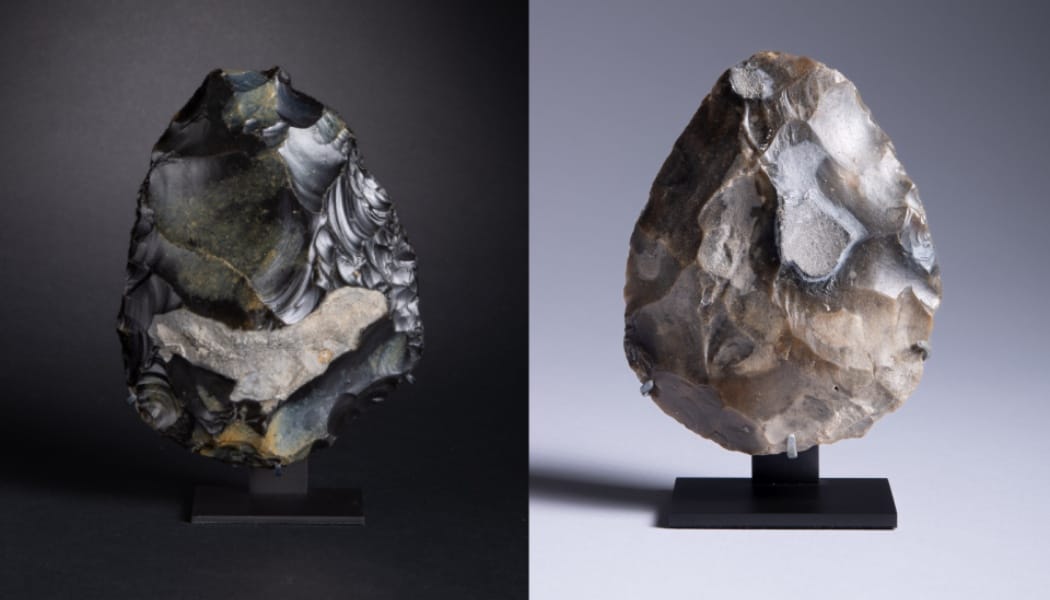
Alistair Hardaker | Image: Flint handaxes discovered on the Happisburgh shoreline, Norfolk (DCMS)
Two prehistoric flint handaxes crafted by some of Britain’s very first human settlers have been placed under a temporary export bar in the hope they can be saved for the nation.
A temporary export bar has been placed on two flint handaxes discovered on the Happisburgh shoreline in Norfolk, believed to be around 500,000 years old, with each recommended at a price of £15,000.
DCMS hopes that a UK museum or institution will step forward to acquire the handaxes, which were exposed after storms cleared away clay on the beach shore, revealing ancient land surfaces underneath. It said the tools provide internationally significant insights into the type of technologies that first enabled humans to survive in northern environments.
The decision to defer an export licence follows advice from the Reviewing Committee on the Export of Works of Art and Objects of Cultural Interest.
Both handaxes were created using a stone or antler hammer to knock off flakes from both sides of a larger piece of flint, giving them strong, skilfully shaped edges suitable for cutting and scraping, and were used without handles. One handaxe has an asymmetrical appearance with small patches of orange-brown staining, measuring 13cm long and weighing 465 grams.
The finds belong with a series of discoveries connected to some of the first human occupation of northern Europe, from a period when what became the River Thames ran a northeastern course through Norfolk, entering the North Sea near the find site.
The Reviewing Committee said that both handaxes met the first and third Waverley criteria for their outstanding connection with our history and national life and their outstanding, global significance to the archaeological, geological and palaeontological study of the most ancient human population of Britain.
Culture Minister Baroness Twycross said the handaxes “present a window into the lives of some of our oldest ancestors. The Britain they inhabited was very different from our own and items like these provide a valuable insight into a world that is extremely difficult to research.
This marks the seventh temporary export bar issued since the start of the year by the Government, following bars placed on items such as a bust of John Gordon of Invergordon, Shock Dog by Anne Seymour Damer, and an archive of the Scots Mining Company.
The decision on the export licence application will be deferred until 2 September 2026. At the end of the initial deferral period, there will be a 15-business-day consideration window for any formal offer to purchase either handaxe at the recommended price of £15,000 (plus VAT of £3,000, which could be reclaimed by an eligible institution). A second deferral period of three months will follow if an Option Agreement is signed.