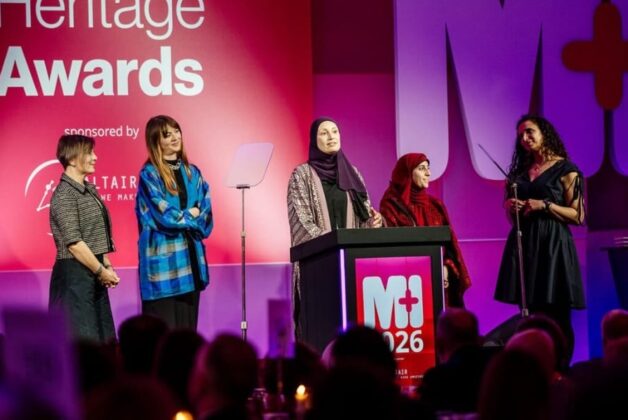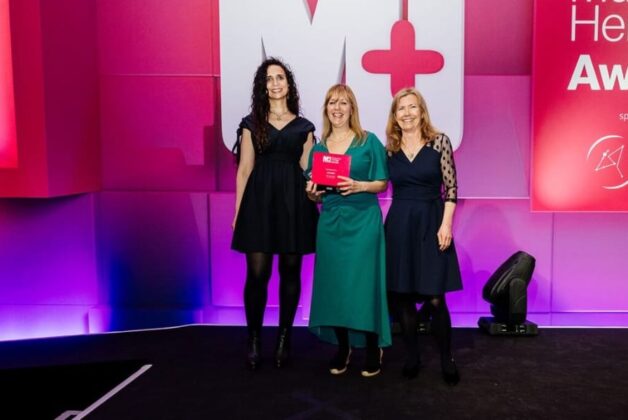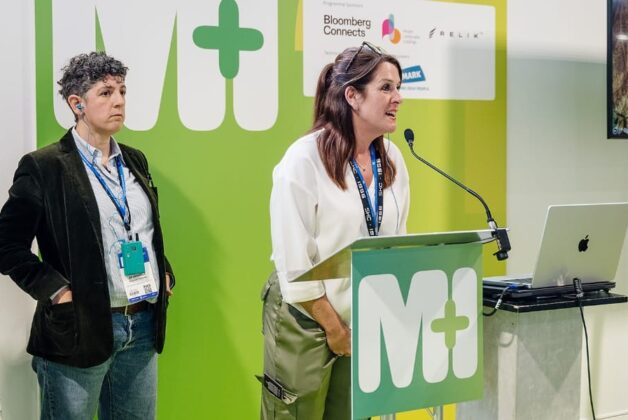

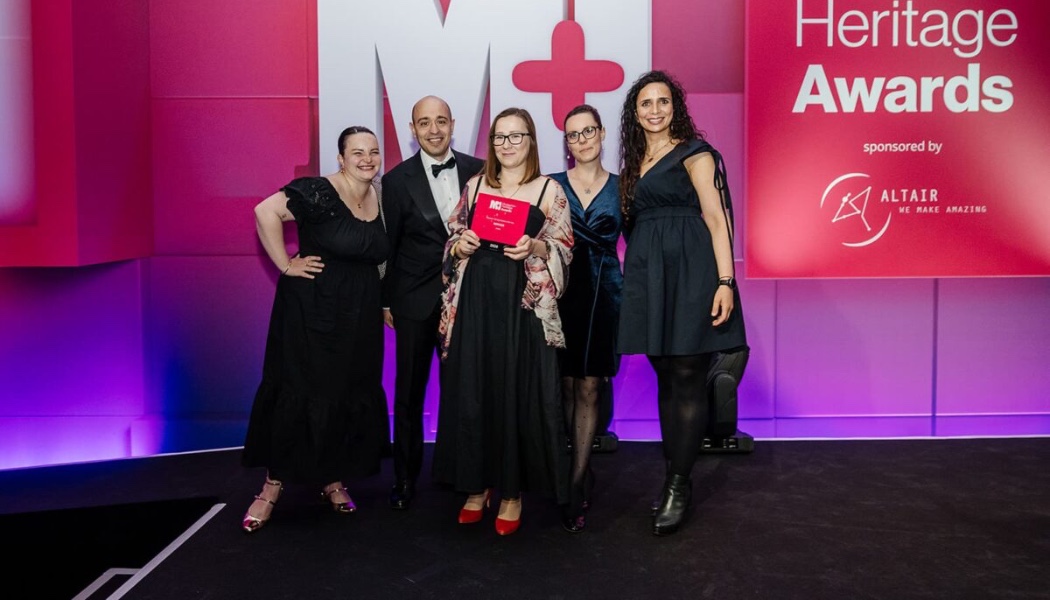
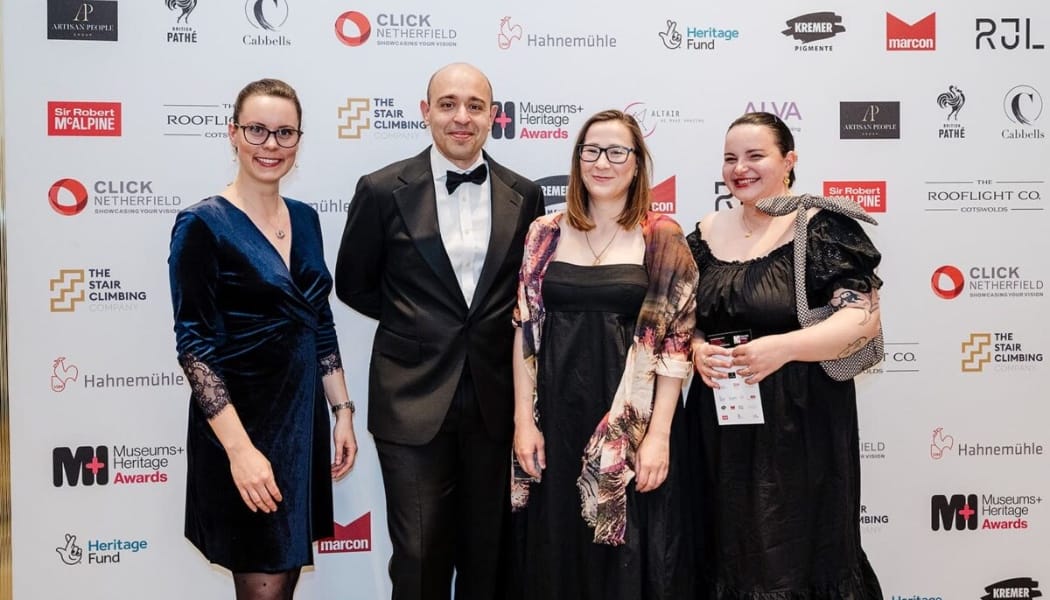
Alistair Hardaker | Image: The Smartify team (second left: cofounder Thanos Kokkiniotis)
Now in its tenth year, the Business of the Year winner’s pitch is not what the technology can do but what a building can actually sustain
Like many popular cultural attractions, Westminster Abbey counts thousands of visitors moving through its building during a given day. But unlike most, every hour the building stops for a one-minute prayer service.
Having recently completed a multimedia guide for the London church and World Heritage Site, cultural travel and museum guide platform Smartify were tasked with making that hourly transition easier.
Smartify’s co-founder Thanos Kokkiniotis explains:”When we built the multimedia guide, we made sure that we had a timed notification. So on the hour, even if someone is immersed in the content and lost in their own world on the screen, there’s a notification that says there’s going to be a service, ‘so eyes up, try to put your device away for a second and listen to that’.”
Smartify’s platform, which allows users to listen to guided tours, scan artworks for more details, and generate custom routes based on interests, won the inaugural ‘Business of the Year’ at the 2026 Museums + Heritage Awards.

Unlike other categories, decided by a panel of independent judges, Smartify’s Business of the Year win was decided by sector-wide vote.
Kokkiniotis said, as the company entered its tenth year, “it just felt that it was the right timing. It was almost like a sign of the times.”
Among its roster of clients is The Tower of London. The queue for the Crown Jewels can run from five minutes on a November Monday to an hour in July.
“We had to work with them to build a system that allows us to read the queue and then change the content that we serve accordingly.”
On busy days the guide switches to a highlights tour. “If you have high throughput, you’re going to end up in congestion,” explains Kokkiniotis.
“Having that ability to balance the interpretation objectives with the operational reality is something that’s key to us. And I think it’s one of the things that has helped set us apart from other suppliers and competition, that our system is very dynamic and real time in terms of how it updates based on the operational reality and the visitor feedback.”

Three waves of demand over 10 years
Smartify started in 2015 as a CIC (community interest company), serving its clients through the covid pandemic.
Kokkiniotis describes three distinct waves in what institutions have asked for. Before COVID, the comparison was the hardware audio guide. “You go into a cultural attraction or a museum, and then you have this sort of 35 minute audio guide. That’s it. There’s no optionality, no personalisation, nothing to bring the living environment around you to life.”
Then the pandemic did in two years what adoption curves had not, including a newfound fear of shared headsets or devices. QR codes went from niche to universal. BYOD (Bring your own device) became the default.
Now in the third wave, Kokkiniotis says venues want something innovative that is also operationally steady and reliable, particularly at high-traffic sites.
Why white label does not work
Just as Westminster Abbey’s guide needed an alert for a prayer service, and Tower of London needs reactive guide times, what keeps the company busy is adjusting its offering for the quirks of each of its clients.
“Something that could work for the Ashmolean wouldn’t necessarily work for the National Gallery or wouldn’t work for the RA. Completely different institutions, completely different collections, different visitor experiences,” said Kokkiniotis.
The company’s stated process is to listen, discover, ideate and co-create, mapping existing operations, interpretation strategy and commercial reality before building. The point is what the building can carry.
“Not every institution can sustain a fully immersive interactive experience with 1,000 users connecting at the same time. You may have a historic house in the countryside with a single Wi-Fi access point.. and then good luck trying to do image recognition across a collection of 500 objects!”
“When we build something, it’s something that is there to stay, it’s technologically sustainable, and it shouldn’t feel like a foreign object, but something the venue’s own team wants to support and promote to its visitors.”
Entries for the Museums + Heritage Awards 2027 are now open — don’t miss your chance to be recognised among the sector’s best.
Entries close midnight on 29 January 2027.
Asked whether anyone has brought a problem technology could not solve, the co-founder says the limit is no longer the technology.
“There hasn’t been something that we found, from a technology point of view, impossible to build or deliver. It’s always operational or commercial constraints that end up being barriers. Especially nowadays, you can build anything. The question is, is it going to be at the right price point for the visitor, is it going to be at the right cost level from a maintenance point of view for the organisation that’s going to host it, and operationally, does it add a burden?”
A recent rollout across seven national museums with HeritageSG, a subsidiary of Singapore’s National Heritage Board, delivered against a run of simultaneous renovations and reopenings. The brief there included what Kokkiniotis calls audience cross-pollination: “If you engage digitally with one of the museums, how can you use that as an opportunity to nudge someone to go to the next museum, which could be two blocks further down?”
A first project with the National Trust for Scotland, at Culloden Battlefield, posed the opposite problem to a crowded abbey. “It was the first time where we had to work on interpretation of an open landscape with very little built interpretation, where there’s lots and lots of history around it, but then it’s all about the content and how we can build great and immersive content to get people to feel the story and the significance of the place.”
The past two months have brought AI translation in 72 languages, text to speech, and a chatbot Kokkiniotis is careful to distinguish from the obvious comparison. “It’s not like a ChatGPT or Claude wrapper. These are actually models that are specifically trained per institution. So effectively you’re building a walled garden to ensure IP protection, curatorial integrity and control on a per institution basis.”
He points out that Smartify has used AI since its launch, when its image recognition technology was unveiled, but not yet called ‘AI’.
What has changed is the work around it. “It’s more about transitioning from cool, innovative technology that we know we can build and we can deploy, into, asking how do we make it compliant, safe, secure, and protective of the IP of the institutions that are using it.”
Why Smartify entered ‘Business on the Year’ at the M+H Awards
Kokkiniotis said the awards entry, and eventual win at the 2026 Museums + Heritage Awards brought two positives.
“It’s the sector’s own awards and the recognition is coming from museums and heritage, from the community itself, and it carries real weight with the people you work with. We’ve won other awards in the past, but that actually meant a lot.”
His case for entering does not depend on winning. “Even if you haven’t won, just being shortlisted is independent proof for institutions that you’re a business worthwhile considering for different projects or opportunities.”
The second positive, was a moment to reflect on the business. “The process itself is actually quite valuable, the way that the application process invites you to think about yourself. Are you worth it? Are you actually a great company? Do you think you can be shortlisted in such a challenging and competitive category?”
Smartify won Business of the Year, voted for by the sector, at the Museums + Heritage Awards 2026. Entries for the 2027 awards are now open, with an early bird rate ended in December 2026.
Entries for the Museums + Heritage Awards 2027 are now open — don’t miss your chance to be recognised among the sector’s best.
Entries close midnight on 29 January 2027.