
Kew Gardens
Alex Lampe, strategy & innovation director & co-founder, Wiedemann Lampe, argues wayfinding can communicate organisational values.
What if you visited the beautiful city of Bath and left thinking it was simply a masterpiece of Georgian architecture? If you didn’t realise that people have travelled there for over two thousand years to bathe, heal, gather and socialise around its sacred springs? What if you spent time at a historically significant country house but never learn what its history can teach you about today? Would you return? Would you have felt enriched, transformed by the visit?
This month, the UK culture secretary Lisa Nandy announced £1.5bn of arts funding – but she also called on cultural organisations to engage visitors more actively. Museum visits in England still lag behind pre-pandemic numbers, and a recent report found that only 30% of museum goers stay engaged after a visit (Manifesto, 2025).
It has never been more important to inspire visitors and send them off with the desire to return.
From a design perspective, wayfinding is a crucial tool to help with this – if approached in the right way. Traditionally, people see wayfinding as directional signs, distilled information and styling. Functional and aesthetically pleasing, yes. But it could be working so much harder.
Every aspect of wayfinding has potential to tell a story. It can be used to support exhibits and exhibitions through inspiration and discovery. If we overhaul our understanding of it (from ‘pointing the way’ to ‘storytelling unfolding across space’), it can transform how visitors navigate a place – and how they feel when they leave.
Here’s how to use it to its full potential…
From functional to emotional
Firstly, think of wayfinding as a shift away from telling people what to do toward crafting experiences that people want to do. “Go here” becomes “if you’re looking for calm, have you considered this spot”, or “keep off the grass” turns into “appreciate the biodiversity you’re protecting”.
Storytelling is information wrapped in emotions – used as part of ‘wayfinding’, it allows visitors to relate, remember and feel something as they arrive, spend time and leave.
Wayfinding too often sits with architecture, when it’s really a visitor experience challenge. Visitor archetypes, their needs, goals and bottlenecks, the distinct modes through which they experience a space, should all inform how you map out your wayfinding. It allows you to reframe the journey beyond simple functional movement and more as an emotional arc – and discover where you can add narrative to make spending time in your space more rewarding.
For example, at the British Library, we learned that at busy times, people coming to study often struggled to find space – and quiet. This insight allowed us to design small ‘nudges’ through the space: “Finding it hard to concentrate? Register for a free reading pass and get access to the Reader Rooms”. “Looking for free things to do? Head to the Treasures Gallery or check out our Entrance Hall display.”
The Young V&A, meanwhile, has designed its signage with its audience front of mind – speaking directly to the young visitor, always pointing out how the exhibits relate to them (“design gives us a voice”, says one sign for example). Since it opened in 2023 (designed with input from more than 20,000 children), the museum has won numerous accolades and boasts consistently high engagement.
Conveying your core values/mission
Approached in this way, wayfinding even becomes an opportunity to communicate your organisation’s core principles.
At New York State Parks’ Planting Fields Foundation, for example, a visitor-centred approach to redesigning the wayfinding system helped us articulate the foundation’s core organisational pillars of ‘For Nature. For History. For Life’. Those went on to inform everything from the new signage and visitors’ guides, to internal KPIs, strategic objectives and cultural programming.
They allowed us to add a layer of interpretation and character to the signage that inspired and invited people to engage beyond their visit (from encouraging ‘no mow May’ to tips on how to discourage deer from eating your plants).
Visitors don’t want to just be told what or where something is. They want to understand what it means, why it’s relevant and how it connects to them. It’s about offering details to motivate and invite action, deepening the connection between visitors and place.
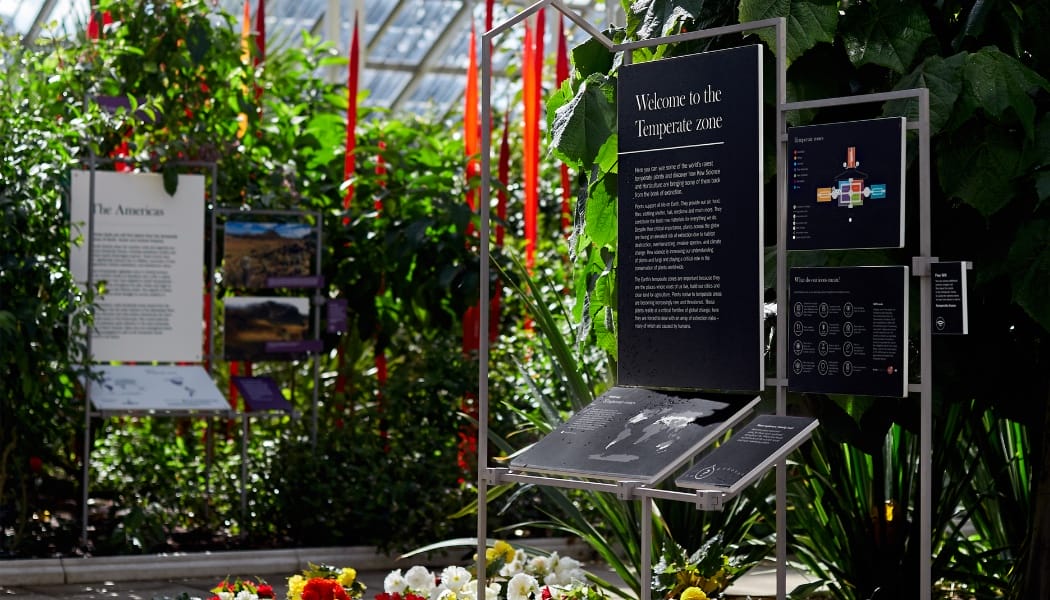
Our work for Kew Gardens’ Temperate House included an interpretation system that illuminated the personal and epic stories of Kew’s plants. The system positioned Kew Gardens as a place where science and horticulture coexist in harmony, bringing the stories of the plants to life and reinforcing Kew’s mission to inspire a love of plants and the natural world. It was so effective that it went on to inform the interpretation beyond the Temperate House.
Think of the space as a whole
This storytelling-wayfinding hybrid also needs to go beyond individual interventions. It’s about seeing the entire site as a unified experience.
For the Louvre Abu Dhabi, we took such a holistic approach, creating distinct districts within a larger, complex site and turning the potentially overwhelming environment into simple, comprehensible zones. This gives visitors an immediate sense of the offer and allows them to build their own journeys with confidence. Whether through nudges, district mapping or reorganised arrival experiences, the aim is always to present the place in a way that feels intuitive and welcoming.
The best wayfinding creates a complex, layered model in which navigation, information and interpretation coexist and reinforce one another. Navigation provides clarity, information provides context and interpretation lends meaning.
So let’s move away from the traditional notion of ‘wayfinding’. Let’s borrow from storytelling, service design and most importantly the visitor experience itself. Call it ‘waytelling’, perhaps. Or ‘interpretive journey design’? ‘Spatial narrative’? It’s the most undervalued tool for engagement – let’s use it better to unlock the positivity that Nandy’s new wave of funding promises.