

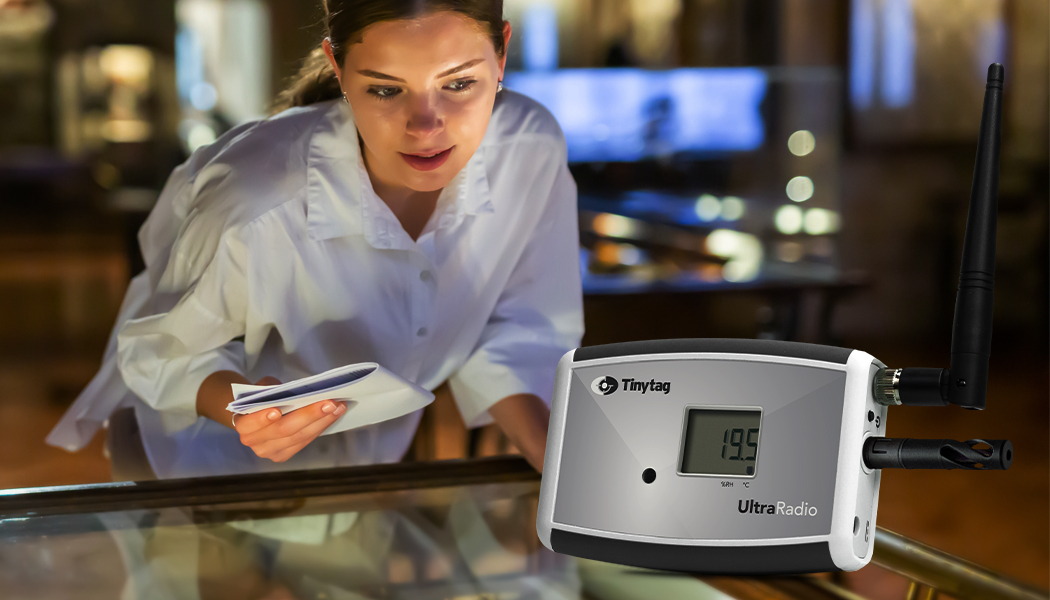
Tinytag explains how logger displays and interchangeable pre-calibrated probes can keep monitoring points in place during calibration.
Environmental monitoring is a central part of caring for collections, but its value extends beyond recording whether a room was warm, cool, dry or humid at a particular moment. Museums, galleries, archives and historic properties need to understand how conditions change over time, how different spaces behave and what those patterns mean for collections, buildings and day-to-day operations.
A single spot reading cannot show the effect of changing seasons, visitor numbers, lighting, heating or ventilation schedules. Nor does one monitoring point necessarily represent an entire gallery or store. Conditions can vary across rooms and throughout the building, particularly in older and adapted buildings, the differences can be especially pronounced.
From readings to useful evidence
A good monitoring programme begins with a question, not a device. Is the aim to understand seasonal behaviour, investigate a concern, compare display and storage spaces, or provide evidence for a conservation decision? Defining the purpose helps determine what should be measured, where loggers should be placed, how frequently readings should be taken and how long the study should run.
Position matters. A logger placed in direct sunlight, next to a vent or close to a frequently opened door may record a genuine local condition, but not one that represents the wider room. Sometimes that local effect is precisely what needs investigating; at other times it can distort the picture. Recording exhibition changes, maintenance work, unusual visitor activity or alterations to heating and ventilation makes trends easier to interpret.
The objective is not to collect the greatest possible volume of data. It is to create evidence that people can use. Temperature and relative humidity records can help conservation and facilities teams identify recurring fluctuations, compare areas and decide whether further investigation or operational adjustment is appropriate. Monitoring supports professional judgement; it does not, by itself, guarantee that deterioration will be prevented or that every collection requirement has been met.
Local awareness and a wider view
For many organisations, the monitoring workflow is as important as the measurement. Conditions may need to be reviewed across several galleries, stores or buildings, while staff working in an individual space may also want immediate reassurance about the current reading.
This is where a logger with a display can be particularly useful. A clear local reading allows staff to check conditions at the monitoring point without opening software or interrupting the recording programme. It can support routine room checks, help colleagues recognise when a space warrants attention and make environmental monitoring more visible to the people working around collections.
The display is not a substitute for reviewing trends. A value that appears acceptable now may conceal earlier fluctuations, while an unusual reading still needs context and investigation.
Tinytag Ultra Radio loggers combine this local visibility on selected models with central collection through the Tinytag Connect system. Readings from multiple indoor locations can be brought together for review, reducing the need to visit every logger simply to retrieve data. Configurable warnings can also support earlier awareness when defined limits are exceeded.
As with any radio system, successful deployment depends on thoughtful positioning and an understanding of the building, because walls, metal shelving, dense collections and other obstructions can affect communication. If radio communication is interrupted, the loggers continue recording locally and forward stored readings when communication returns. The system requires a compatible receiver and Tinytag Explorer Connect; the loggers are not standalone devices.
Keeping monitoring in place during calibration
Calibration and maintenance create another practical challenge. If an entire fixed logger must be removed, a monitoring point may be unavailable while equipment is serviced. New Ultra Radio variants with interchangeable digital stub probes offer a different approach for temperature, or temperature and relative humidity monitoring.
A pre-calibrated replacement probe can be exchanged while the logger remains installed. This can reduce disruption, simplify calibration rotation and avoid returning the complete unit solely for probe calibration. For museums managing many monitoring points, that can make planned maintenance easier to organise.
The display and stub-probe variants address different needs, and some models combine both features. The important decision is not whether every location needs the newest configuration, but which workflow best suits each space. A public gallery may benefit from discreet local visibility; a store may prioritise central review; a monitoring point that must remain continuously represented during planned calibration may particularly benefit from an interchangeable probe.
Monitoring as a shared responsibility
Effective environmental monitoring connects conservation knowledge with practical building management. Conservators understand collection sensitivities and significance; facilities teams understand plant, controls and building behaviour; curators and front-of-house colleagues can provide context about how spaces are used. Data becomes more valuable when these perspectives are considered together and when responsibilities for reviewing readings and responding to exceptions are clear.
Tinytag by Gemini Data Loggers has supported environmental monitoring across museums and conservation settings for over forty years. Our role is not simply to supply instruments, but to help organisations select an appropriate monitoring approach, understand system requirements and maintain dependable records over the long term.
The most useful monitoring programme is not the one with the most devices or the most complex technology. It is the one built around clear conservation questions, representative measurements, thoughtful interpretation and a workable response process.
Displays, central oversight and interchangeable probes can all improve that process, but their real value lies in helping museum and heritage teams turn environmental readings into informed, proportionate action.
Discover more about Tinytag Ultra Radio and connected environmental monitoring here: https://www.geminidataloggers.com/data-loggers/tinytag-ultra-radio