‘Decolonising your planetarium’ includes a checklist that can be used by when communicating scientific achievement with visitors
We The Curious has published a new guide for science communicators to help present work through a decolonising lens.
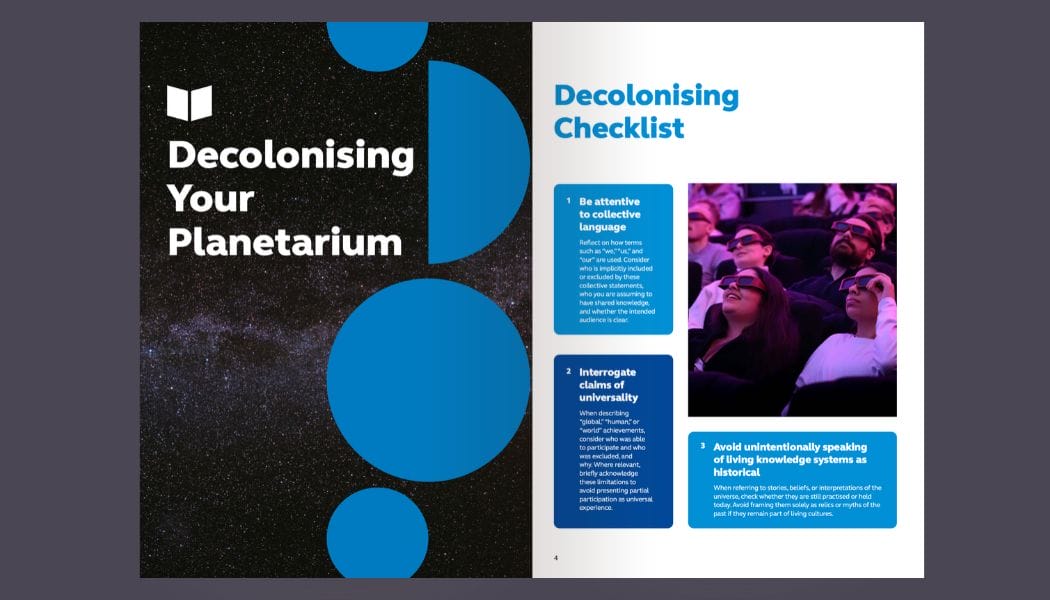
The guide, ‘Decolonising your planetarium’ provides a checklist for science communicators who want to remove barriers to engagement through more inclusive language.
It was prepared by Reo Lewis, PhD Researcher in Post Colonial Linguistics at University of Exeter and University of Bristol.
The guide suggests ways in which adjustments to language and structure can help to better engage with visitors more inclusively. While the guide focuses on scripted planetarium shows, We The Curious says the principles can be applied more broadly across the sector.
“We decide where the story begins, whose discoveries we mention and how we imagine humanity’s place in the universe. Those are storytelling choices,” said Lewis.
The guide’s checklist includes points such as ‘Be attentive to collective language’, ‘Reflect on why particular cultural examples are included’, and‘Reflect on future-facing narratives and metaphors’.
One checklist point suggests: “When describing “global,” “human,” or “world” achievements, consider who was able to participate and who was excluded, and why. Where relevant, briefly acknowledge these limitations to avoid presenting partial participation as universal experience.”
Introducing the guide, Planetarium Manager at We The Curious, Adam Richardson explained: “We learnt that some of the students’ enthusiasm for space had been dampened by concerns around climate change and social justice.
“This included a disapproval of how many key industry figures talk about human space travel using language which echoes historical colonisation. We realised that when we talk about if humans will ever live on Mars, we also needed to ask should humans ever live on Mars.”
The guide is available via the We The Curious website.