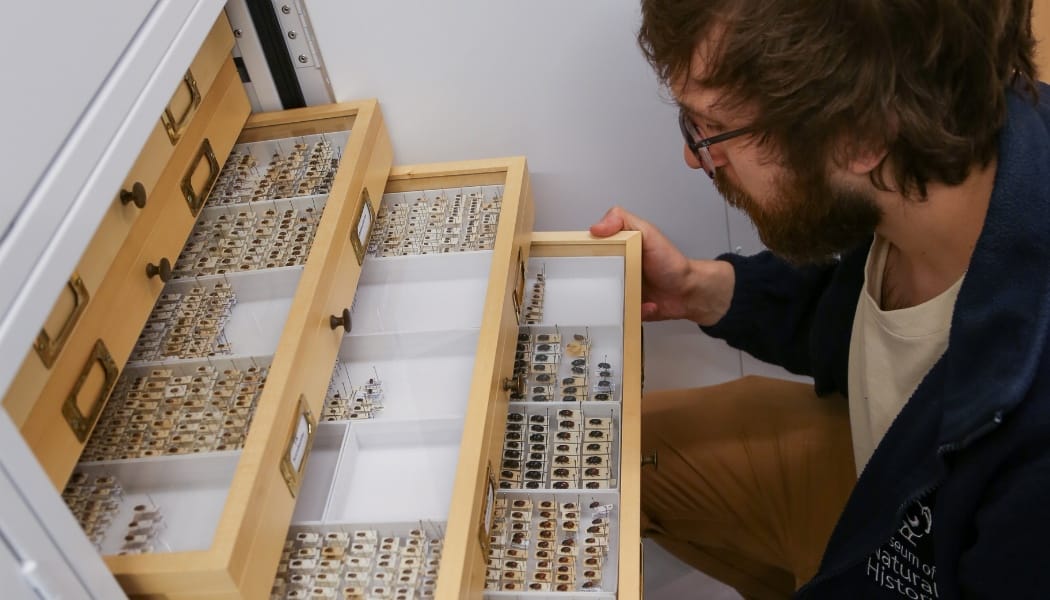
Alistair Hardaker | Image: Collections Assistant Louis Lofthouse with drawers of dung beetles from the Museum of Natural History (Museum of Natural History, University of Oxford)
Universities of Oxford and Cambridge to establish DiSSCo UK Central England Hub, digitising 1.1 million natural history specimens across 23 museums and herbaria.
The Universities of Oxford and Cambridge are to lead a network of 23 museums and herbaria to digitise over 1.1 million natural history specimens.
The two universities will establish the DiSSCo UK Central England Hub over the next two years. Together they steward over 12 million specimens, which they describe as the largest natural science collection in the UK outside London and Edinburgh. The project aims to contribute 1,195,419 specimen records to a national dataset using technologies including high-throughput imaging and AI.
The project is part of DiSSCo UK, a 10-year national programme funded through the UK Research and Innovation Infrastructure Fund and delivered through the Arts and Humanities Research Council in partnership with the Natural History Museum. DiSSCo UK aims to make around half of the UK’s 140 million natural science items digitally accessible over the next decade.
The Natural History Museum (NHM) has recently appointed Sarah Addezio as Programme Delivery Director for DiSSCo UK.
The Central England Hub unites four university collections: the Museum of Natural History and the Oxford University Herbaria at Oxford, and the Cambridge University Herbarium and the University Museum of Zoology at Cambridge. It also supports a node network spanning from Gloucestershire to Suffolk. Norwich Castle Museum and the University of Leicester Herbarium will act as digitising nodes, with eight further sites receiving help to prepare collections and nine more benefiting from online training.
The project focuses on British plants and insects collected over the last two centuries, with an emphasis on East and Southeast England. According to the partnership, this includes nearly 771,000 newly digitised specimens, providing a historical baseline for understanding species turnover and shifts in flowering times caused by climate change. The data will support regional restoration efforts including the Wildlife Trust’s Great Fen project.
Professor Sam Brockington, professor of evolution at the University of Cambridge and project lead, said: “The project will combine the strengths of two world-leading universities to deliver digitised UK biodiversity data at scale and transform digitisation capacity across England’s central belt. We will embed digitisation within regional communities tackling biodiversity loss and climate resilience.”
Zoë Simmons, project co-lead and head of life collections at the Museum of Natural History, University of Oxford, said: “Through this partnership we will be able to realise our aspirations for data sharing at a global scale. The information released will inform and support research from a diverse portfolio of subjects and researchers, opening the collections to a new era of investigation.”
The resulting data will be freely available through the Global Biodiversity Information Facility. Alongside the Oxford and Cambridge leads, partners include the University of Leicester Herbarium, Norwich Castle Museum, Colchester Museum, Ipswich Museum, Peterborough Museum, the Pitt Rivers Museum, Northampton Museum & Art Gallery and Saffron Walden Museum, among others.