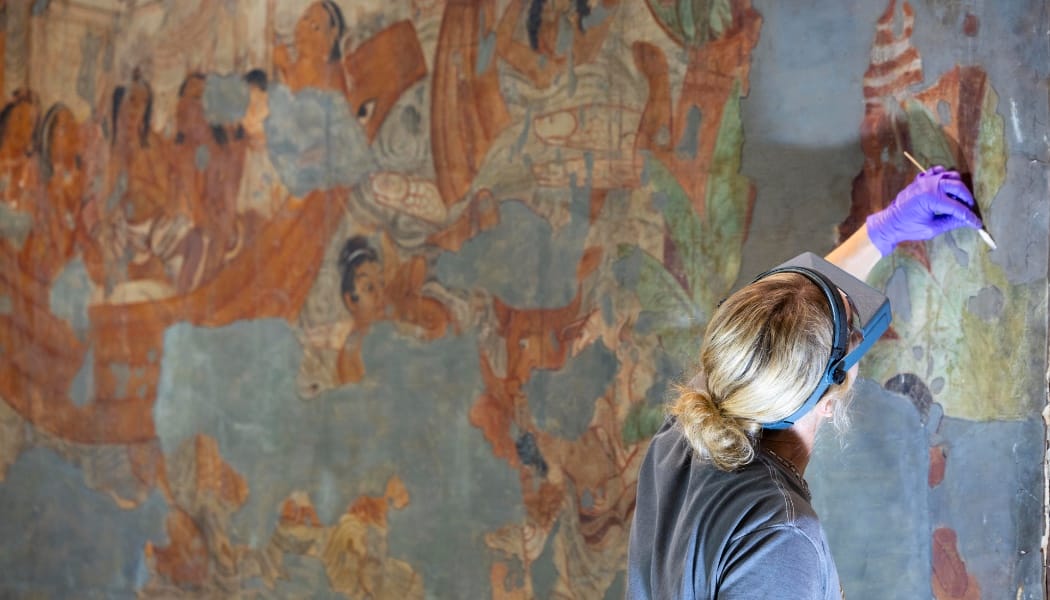
Alistair Hardaker | Image: Independent paintings conservator Sophie Reddington working on a 5m-wide copy of a painting inside the Ajanta (c) David Parry
National Lottery Heritage Fund backs redesign of gallery last updated 30 years ago, with rare objects and contemporary works to go on display.
V&A South Asia gallery to reopen in 2028 after £4m transformation
Meta description: National Lottery Heritage Fund backs redesign of gallery last updated 30 years ago, with rare objects and contemporary works to go on display.
The V&A has announced a £4m funding commitment from the National Lottery Heritage Fund to transform its South Asia gallery, which will reopen in spring 2028.
The redesigned gallery will display rare historic objects, many not seen in public for decades, alongside new acquisitions and modern and contemporary works. The gallery was last updated more than 30 years ago.
Fresh research and interpretation will explore the colonial history of the collection and the story of how these works of South Asian heritage came to the UK. The V&A received initial development funding of £250,000 in September 2024.
The gallery will feature new interpretation and audio-visual technology. It will be structured around a narrative exploring South Asian artistic production across three periods: early and medieval South Asia (circa 3000 BCE–1500 CE), early modern (circa 1500–1800 CE), and modern (circa 1800 CE–present).
Modern and contemporary South Asian art and design will be shown in the gallery for the first time, including contemporary art from Bangladesh and its diaspora, acquired with support from Durjoy Bangladesh Foundation. The foundation’s support also includes a five-year programme of acquisitions, commissions and curatorial research.
Eilish McGuinness, Chief Executive, The National Lottery Heritage Fund, said: “The interpretation and display of this globally important collection has been informed by communities from the South Asia diaspora, brings rare items to a wider public, enriching lives and enabling everyone’s heritage to be recognised and shared more widely.”
Items to go on display include a five-metre-wide copy of a painting inside the Ajanta caves, depicting the Jataka tales. The original paintings date from the first century BCE to the fifth century CE. The V&A’s copy was commissioned in 1872 and created by students of the Bombay School of Art under John Griffiths. It will undergo conservation at V&A East Storehouse until late summer 2026.
An 18th-century ivory domestic shrine in the form of a South Indian temple dedicated to Vishnu will also be displayed, alongside The Kochi Ceiling, a painted and carved 19th-century wooden temple ceiling from South India. The ceiling has been in storage for over 70 years and was last on display in 1955.
Tristram Hunt, director of the V&A said the funding would create “a vibrant new space where historic masterpieces sit alongside the work of leading contemporary artists, questions of provenance and colonial history are addressed, and where visitors can engage with the rich influence of South Asian culture and creativity.”
The V&A’s collection of work from South Asia contains around 50,000 objects spanning 3000 BCE to today.
The new gallery is being co-produced with South Asian diasporic communities through co-curation, co-design and co-programming. Workshops with communities have shaped the gallery’s development.