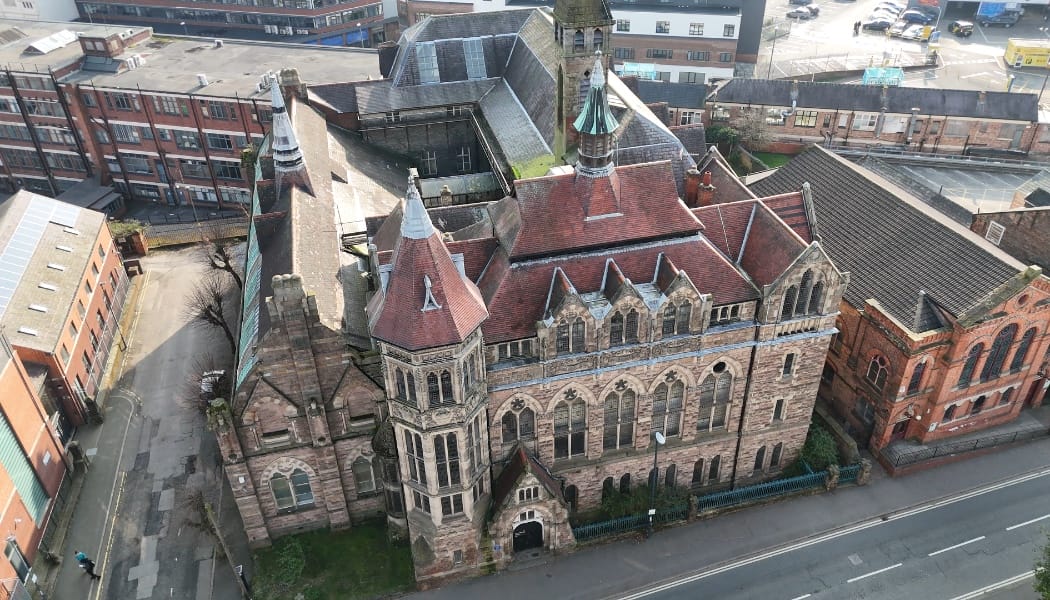
Alistair Hardaker | Image: Derby School of Art (Andy Savage)
Victorian Society’s 2026 endangered list includes ten Grade II and Grade II* buildings selected from public nominations across England and Wales.
The Victorian Society has published its 2026 list of Top Ten Endangered Buildings in England and Wales.
The list, launched by Griff Rhys Jones OBE on Tuesday 28 April, was selected from nominations made by the public. It includes two Grade II* and eight Grade II listed buildings.
Many of the buildings remain vacant, underused, or have no clear plans for repair or reuse.
Among them is the former Derby School of Art, a Grade II* listed building, which now stands empty. The Victorian Society is calling for a clear plan to bring building back into use before further deterioration.
The Victorian Society’s Top Ten Endangered Buildings 2026 (in no particular order):
Hackney Borough Disinfecting Station, London. Grade II, Gordon and Gunton, 1901
Tees Transporter Bridge, Stockton-on-Tees/Middlesbrough. Grade II*, Engineer: G.C. Imbault, constructed by Sir William Arrol and Co Ltd, 1911
New Market Buildings Bridgnorth. Grade II, Robert Griffiths of Quatford, 1855 -1859
Former Strand Railway Station and Railway Men’s Club, Barrow in Furness. Grade II, E. G. Paley, 1863
Faenol (Vaynol) Mausoleum, Pentir, Nr Bangor. Grade II, Henry Kennedy of Bangor, late 1870s.
Oakes School, Huddersfield. Grade II, Charles Fowler, 1873; extended by Ben Stocks, 1885
Parndon Hall, Harlow. Grade II, Possibly Joseph Clarke, 1867
St Michael’s RC Cemetery Chapel, Sheffield. Grade II, Charles Hadfield, 1898
Derby School of Art, Derby. Grade II*, F.W. Waller, 1876 with additions 1899
Former Library and Mechanics Institute, Devonport. Grade II, A, Norman, 1843-44
Victorian Society president Griff Rhys Jones said: “The Victorian Society is drawing your attention to important buildings that are under threat from decay or neglect. We have had great results in the past. But unless we look to them, deserted or abandoned, fine and beautiful structures can be subject to arson attacks or continued decay.
“They are each part of the character and quality and history that made Britain and can continue to make Britain.”
James Hughes, director of the society, added: “These buildings were created with foresight, ambition and a strong sense of civic purpose. Too often today they are left without clear ownership, investment or direction. With the right commitment, every one of them could have a viable future; what is needed now is the will to act.”