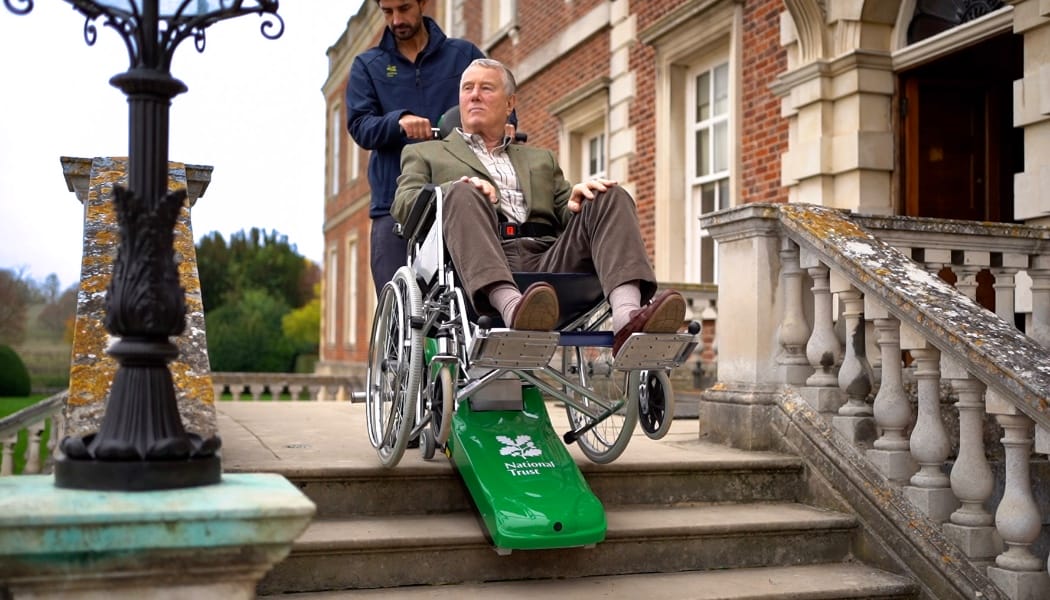
Company’s director Emma Persey on portable stair climbers for heritage sites, noting 60% of disabled visitors avoid inaccessible buildings.
The Roman Baths in Bath offers visitors the chance to explore 2,000 years of history. Wimpole Hall, a Grade I listed National Trust property, features a spectacular Georgian mansion and working farm. Jersey Heritage’s castle promises panoramic views across to Normandy. All compelling visitor experiences, until you count the stairs. For anyone with limited mobility, these sites would traditionally present an impossible barrier. Yet all three now use portable stair climbers to make their historic buildings accessible without permanent installations, without marking original fabric, without lengthy conservation approvals.
Emma Persey, Managing Director of The Stair Climbing Company, has spent 12 years dismantling the assumption that historic buildings and accessibility are fundamentally incompatible. As a Museums + Heritage Awards sponsor, her company works with heritage organisations facing constraints that feel insurmountable: listed status, conservation requirements, winding staircases, fragile materials. The solution she offers doesn’t require structural change, but the bigger shift she’s learned isn’t about the technology at all.
Understanding the scale of exclusion
Museums know accessibility matters. Understanding who’s already been excluded is harder. “There are statistics that evidence over 60% of people with a disability will choose not to visit a venue or inaccessible building because of their lack of facilities,” Persey notes. “So this is before they’ve even planned a visit.”
Museum visits tend to be group experiences: families, friends across generations. An inaccessible building excludes more than one person. “Museums are destined to isolate individuals that can’t attend, cannot access the building, and cannot take part in an inclusive visit,” Persey explains. The ripple extends to those who would have come but don’t even start planning.
When accessibility becomes part of the museum’s offer, the dynamic shifts. “If accessibility is on the agenda for the museum, then the potential customer can start planning their visit with ease, making the customer experience much more seamless, and likely to recommend to fellow friends and colleagues for additional future visits. That can increase the entrance takings for the museum.”
The safety dimension carries equal weight. Without evacuation routes for visitors with limited mobility, museums carry significant responsibility. “If there are no evacuation points within the museum, there is a responsibility that if something was to go wrong and there is no way to evacuate a person with limited mobility, the consequences could be catastrophic. It’s not just a moral argument, but it’s a responsibility.”
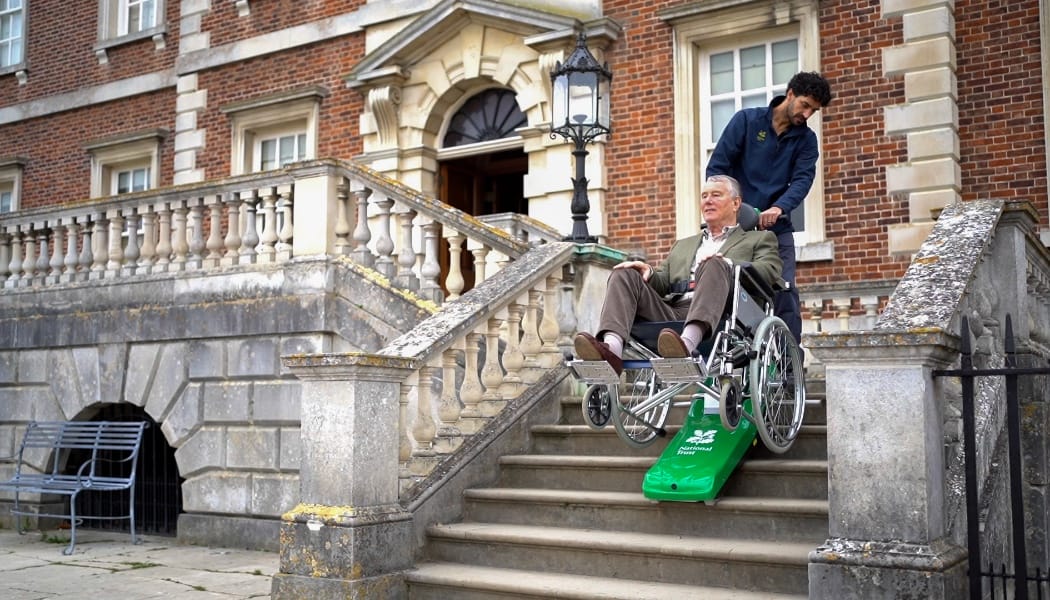
Working within conservation constraints without permanent installations
Most heritage professionals know the conversation well. A museum wants to improve accessibility, but the building is listed. Conservation requirements feel prohibitive. Permanent installations would require approvals that may never come, or take years to secure. The assumption becomes that accessibility improvements are simply not realistic for historic buildings.
Persey’s answer challenges the entire premise. “This is an easy one for us. We aren’t really constrained by listed buildings and conservation requirements because our stair climbers are not a permanent fixture. They don’t mark the stairs or the floors. They don’t cause any change to the existing building.”
The stair climbers can be used when needed, then stored or moved to different staircases throughout the building or to external steps. At the Roman Baths, “they are probably more protective and sympathetic to the fabric of the building than some other solutions.”
Conservation teams sometimes need to understand how the equipment operates before recognising its viability. “It’s more helping others to understand that you can provide access easily without constraints, and that is those who are working in conservation, helping them to understand how the stair climber operates, how you can improve accessibility without having to be tied to constraints.”
Heritage organisations choose this approach for practical reasons. “They are looking for a solution that can minimise the impact on their building while still providing an inclusive experience for everyone.” The goal is families visiting together, groups of friends exploring the same spaces, all generations experiencing the journey without separation. “They need something that is not a permanent fixture, that is sympathetic to the fabric of the building. And they want to be inclusive.”
Addressing visitor apprehension and unfamiliarity
At National Trust properties, many visitors feel apprehensive when they first see a stair climber. The technology itself works smoothly. Modern devices glide up and down stairs, can be vinyl-wrapped to match building aesthetics, bear no resemblance to dated medical equipment.
The challenge is unfamiliarity. “Working with a piece of technology can be quite daunting for the very first time. It’s like driving a car for the first time. You have to be comfortable and familiar with the solution before you can feel confident at using it.”
The Stair Climbing Company addresses this through videos shared in advance, talking visitors through what to expect, and practice runs before actual visits. “So it’s really important that when we consider accessibility, we look at the whole picture, rather than just how clever the technology is or what it’s capable of. Accessibility then becomes much more part of the journey rather than about the piece of technology.”
Planning accessibility throughout the customer journey
Museums typically direct their accessibility efforts toward getting visitors from outside to inside the building. Persey encourages a broader perspective. “The most common request for what we do is moving people from outside to the inside of the building. But what we’ve proven is that actually the bigger picture is providing a customer solution throughout the customer journey that takes them all the way through the building, as anybody else would be able to walk through the building, ensuring that there is a smooth transition and it’s a seamless process for the visitor.”
The work begins before anyone arrives at the building. Website information about what solutions are available. Clear communication that the museum has thought about access. Staff prepared to welcome visitors confidently. “What’s distinctive is providing the accessibility solution in advance of a visit, whether that is providing promotional material on the website as they are planning their visit, whether that is promoting the stair climber as an access solution so that visitors are aware there is a solution in place, making sure that the staff are trained to use it and can make the customers feel welcome and at ease.”
Applications across diverse heritage settings
The Stair Climbing Company works across diverse heritage settings. Grand National Trust staircases with ample room for regular traffic alongside stair climber users. Luxury hotels like Claridge’s and the Lancaster London. Heritage sites with particular challenges: Biddulph Grange with over 400 outdoor steps, or the Jersey castle requiring navigation of 250 steps to reach panoramic views.
“They will happily accommodate winding staircases, stairs that go into basements, and all types of material staircases,” Persey explains. The Jersey project tested the limits of what seemed feasible. “This worked brilliantly. Yes, it was a challenge. But we managed to achieve it and Jersey Heritage were really keen to make sure that their historical venue was accessible for all. So while some are challenging, we still have a great sense of achievement at the end.”
Modern equipment looks nothing like the archaic devices some people might remember. “They can be vinyl wrapped to match the branding. They’re not archaic medical devices like they once were. And they glide up and down the stairs. This actually often creates a really positive response from others.”
At Wimpole Hall, the impact went beyond practical access. “When we worked at Wimpole Hall, the manager became quite emotional as a number of his wheelchair users who had never been able to access Wimpole Hall can now do that with the support of the stair climber. And this has been transformative for them.”
Staff concerns typically centre on operation: who will use it, how will they manage it as part of regular duties. “I think the initial concern is about the staff using the solution, and mostly this comes down to seeing the stair climber in action, really good training, and lots of practice.” Once the equipment becomes part of everyday operations, “the change is transformative with both staff and the visitors.”
How accessibility conversations are changing
Twelve years in the heritage sector has given Persey a clear view of how accessibility conversations are changing. “We are contacted not because there are problems. We are contacted because they are looking for solutions and it’s our job to come up with that solution. Accessibility is definitely becoming much more on the agenda. Not always about full accessibility, but about the small steps to improving accessibility.”
Technology itself can be the stumbling block until museums see it working in practice. “Often it is the technology and the fear of the technology that hold people back. Until they see it and until they experience it. And their attitudes start to change and they start to realise what is possible. And so we are seeing more of this, and we are seeing actually what good looks like, which is a really positive step.”
Her advice to heritage sites still exploring how to improve accessibility removes the pressure to solve everything immediately. “You don’t have to create full accessibility overnight. And the small improvements that you make add up and over time create a bigger impact. It doesn’t need to be an expensive, costly, difficult project. And it doesn’t need to be a scary experience. It just requires lots of questions, lots of open minds, and exploring what is possible for the short term and the long term.”
Museums working in historic buildings often believe their particular constraints make accessibility uniquely difficult or expensive to address. Persey’s experience across dozens of heritage sites suggests something simpler. Her advice: “…not to be scared about approaching an area which is currently unknown. Because there is a lot of support and advice out there. And your visitors and guests will appreciate that and you will see an improvement in attendance, recommendations, and an increase in visits as a result. It doesn’t have to cost to gain.”
The Stair Climbing Company is a sponsor of the Museums + Heritage Awards. For more information about accessibility solutions for heritage buildings, visit The Stair Climbing Company.