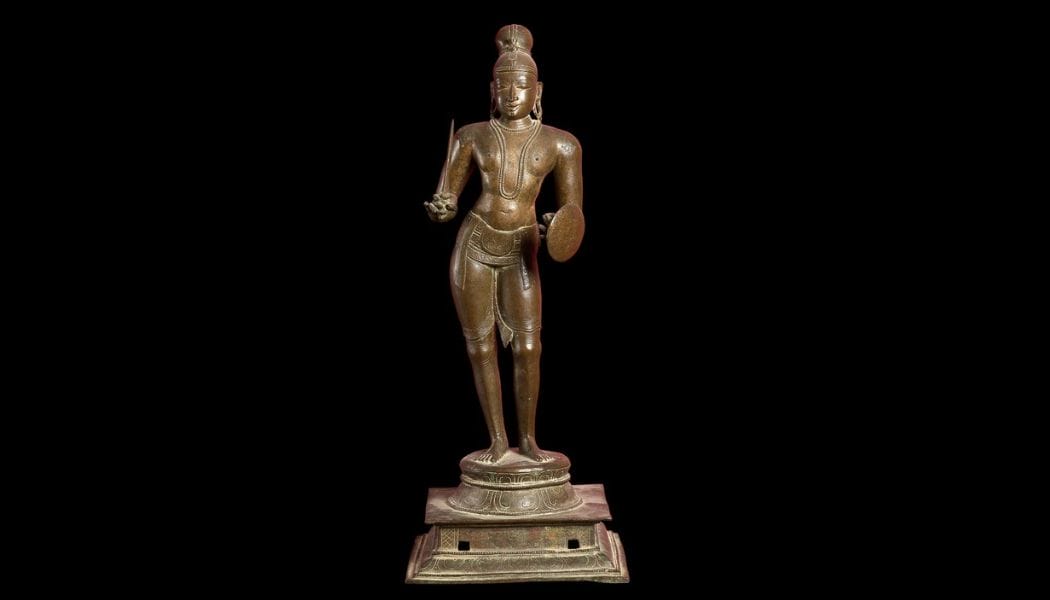
Alistair Hardaker | Image: Tirumankai Alvar. Ashmolean Museum, University of Oxford
Museum returns statue to India after five-year provenance investigation initiated by French archival research.
The Ashmolean Museum has returned a 16th-century bronze statue to the Government of India following research into the object’s provenance and liaison with Indian authorities.
The handover of the statue of Saint Tirumankai Alvar took place at the High Commission of India in London on 3 March 2026 in the presence of Dr Xa Sturgis, director of the Ashmolean, and Professor Mallica Kumbera Landrus, head of the museum’s Department of Eastern Art.
The museum acquired the statue in good faith in 1967 from private collector Dr J R Belmont. In November 2019, an independent French scholar alerted the museum to research indicating that a photograph of the bronze, taken in 1957 in the temple of Shri Soundarrajaperumal Kovil in Tamil Nadu, had been identified in the archives of the Institut Français de Pondichéry and the École française d’Extrême-Orient.
The Ashmolean contacted the Indian High Commission in December 2019, requesting further information and indicating willingness to discuss the possible return of the object. A temple executive officer filed a police report in February 2020 noting that a modern replica had replaced the original bronze. The Indian High Commissioner made a formal claim for the return on 3 March 2020.
Professor Kumbera Landrus conducted further research in India in July 2022, meeting officers of the Idol Wing and senior officials from the Archaeological Survey of India, the French Institute, and temple representatives. The museum commissioned metal analysis of the bronze and submitted results to inform a full report on its provenance.
The Ashmolean’s Board of Visitors supported the claim. The University Council approved the claim on 11 March 2024 and referred the case to the Charity Commission for England and Wales, which approved the transfer in December 2024.
“The Ashmolean is pleased to see this important object returned to India and we are grateful to the Indian authorities and scholars who have helped establish its provenance,” said Dr Xa Sturgis.
“The Museum and the University of Oxford are committed to ethical collections practices and continued research into our collections, their origins and their history.’
A spokesperson for the High Commission of India, London, added: “The Government and the people of India appreciate this action and effort, which is not merely restoration of an object of art, but the reunification of an icon of faith with its intended shrine, restoring memory, and enabling cultural continuity.”